
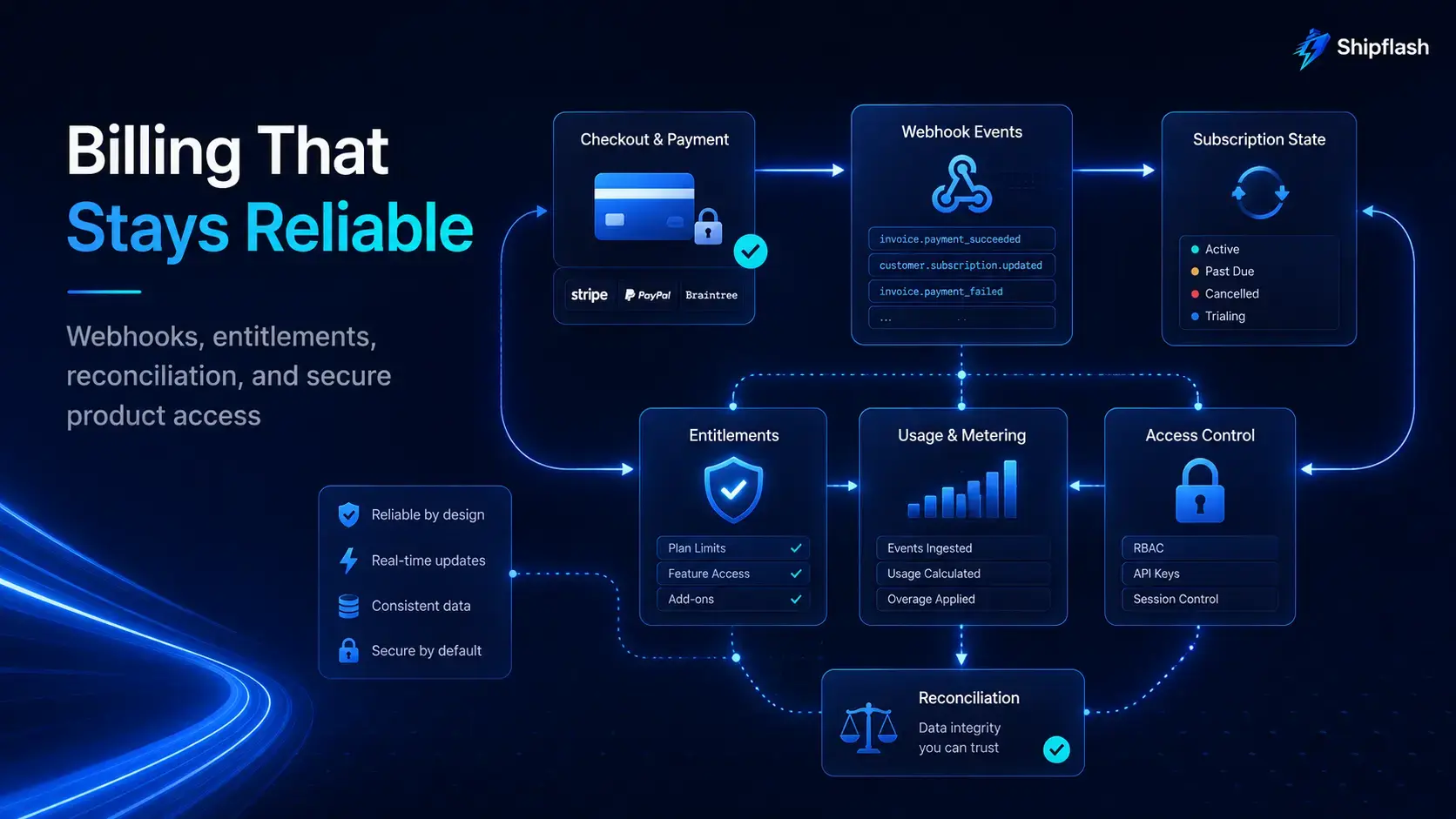
A customer completes checkout. The payment provider reports success. Your application redirects them to the dashboard.
It looks like the billing integration is finished.
Then the difficult questions begin.
What happens when the customer upgrades while an older webhook is still being retried? Should access disappear immediately after a failed renewal? How should a partial refund affect prepaid credits? What happens when the payment provider says the subscription is active but your database still shows it as canceled?
These are not unusual edge cases. They are the normal operating conditions of a real subscription product.
A checkout page connects your application to a payment provider. A SaaS billing architecture determines how money, subscriptions, usage, entitlements, and product access remain consistent after that checkout.
A production-ready billing system does not ask only, “Did this customer pay?” It must also answer, “What may this customer use right now, why do they have that access, and can we prove the decision?”
What is SaaS billing architecture?
SaaS billing architecture is the system that connects your product catalog, payment provider, subscription state, usage records, entitlements, and application authorization. A reliable design receives provider events through verified webhooks, stores them idempotently, updates internal access records, and runs reconciliation jobs to detect missed or conflicting state.
The most important architectural decision is to avoid treating one provider field—such as subscription.status—as the complete business model.
Instead, separate the system into distinct responsibilities:
- Product catalog: What you sell.
- Provider state: What the payment platform reports.
- Internal entitlements: What the customer may use.
- Event history: What happened and how it was processed.
- Usage or credit records: What the customer consumed.
- Reconciliation: Whether your records still agree with the provider.
This separation creates a billing system that is easier to test, operate, debug, and adapt when pricing or payment providers change.
Why Checkout Is Not the Billing System
Checkout is only one transition in a much longer lifecycle.
Before checkout, your application must know which product, price, currency, billing interval, and pricing model the customer selected. After checkout, the system must create or connect a customer record, record the purchase, activate the correct access, process renewals, respond to plan changes, handle failed payments, support cancellations, and preserve an audit trail.
The complete flow looks more like this:
Product catalog
      ↓
Checkout creation
      ↓
Payment provider
      ↓
Verified webhook ingestion
      ↓
Normalized provider state
      ↓
Internal entitlement calculation
      ↓
Application access checks
      ↓
Usage and credit accounting
      ↓
Reconciliation and operator review
The browser redirect after checkout is useful for customer experience, but it should not be trusted as proof of payment.
A user may close the page before the redirect finishes. A malicious client can attempt to call a success route directly. The payment may require additional processing. The provider may complete the transaction after the browser session has disappeared.
The reliable confirmation arrives through a server-to-server event or a verified provider API response.
This is why production billing belongs inside the broader foundation of the application rather than being added as an isolated payment button. A strong billing layer depends on the authentication, authorization, database, observability, and operational practices described in a production-ready SaaS foundation.
The Six Layers of Reliable SaaS Billing Architecture
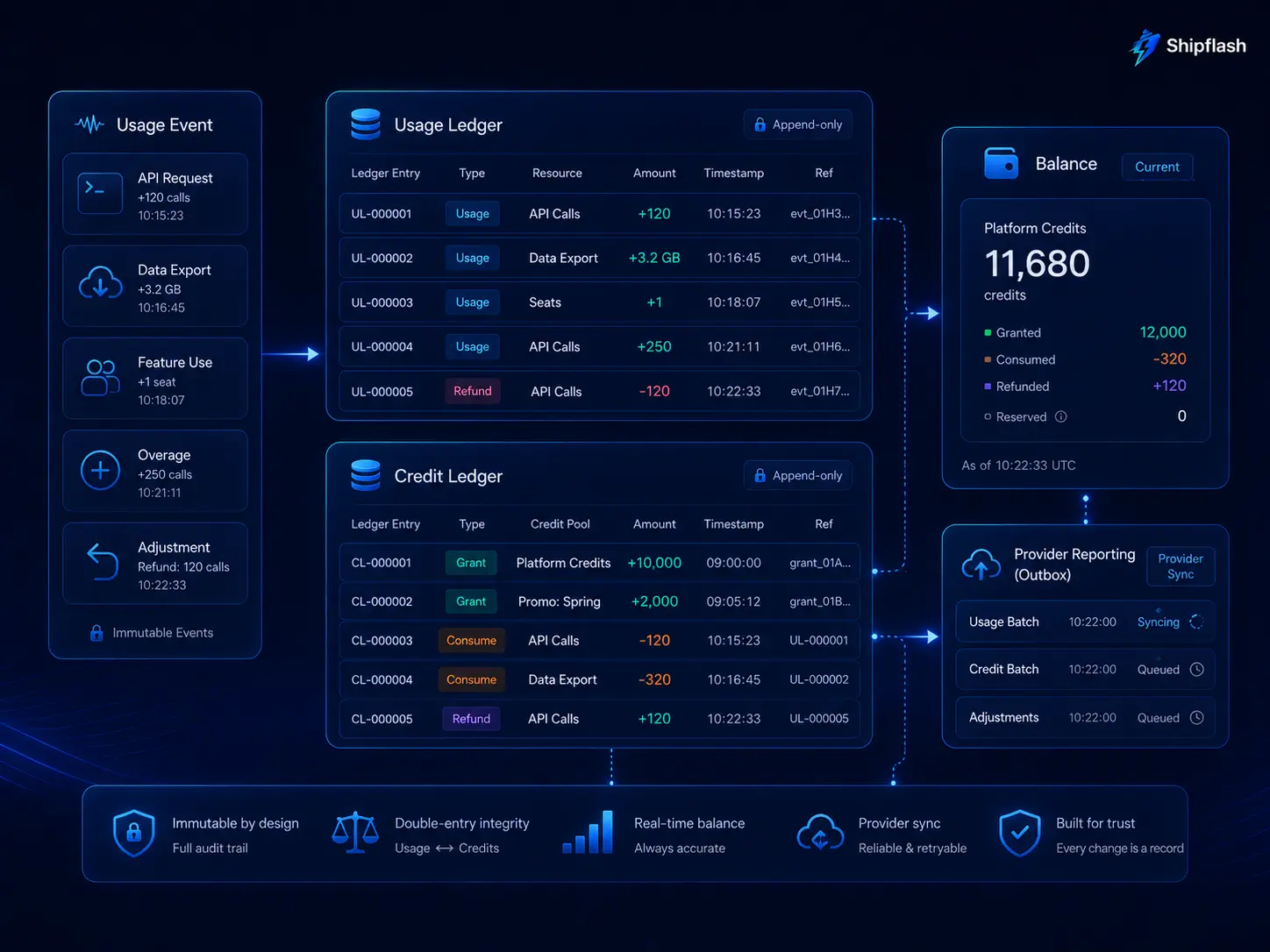
A maintainable billing system gives every kind of information a clear owner.
| Layer | Primary responsibility | Typical records |
|---|---|---|
| Product catalog | Defines what customers can purchase | Products, prices, plans, intervals, credit packs |
| Provider state | Mirrors important external billing facts | Provider customers, subscriptions, invoices, transactions |
| Entitlement engine | Determines what the product permits | Features, limits, grants, expiration dates |
| Webhook event history | Records asynchronous provider communication | Event ID, payload, status, attempts, error details |
| Usage and credit ledger | Records consumption and remaining value | Usage events, credit grants, debits, refunds |
| Reconciliation | Detects and repairs differences | Drift findings, repair attempts, review status |
These layers can live inside one application and one database. You do not need six microservices.
The value comes from separating their responsibilities in the domain model and codebase.
A small SaaS might implement the layers as several Postgres tables, a billing feature folder, provider adapters, a webhook route, and scheduled reconciliation jobs. A larger company might split some of them into services. The underlying boundaries remain useful at either scale.
A practical billing data flow
When a subscription starts, the workflow should resemble this:
- The customer selects a catalog item using an internal product identifier.
- The server maps that item to the active provider price.
- The server creates checkout with trusted metadata.
- The provider processes the payment.
- A signed webhook reaches the application.
- The application stores the event using a unique provider event ID.
- A handler updates the local subscription projection.
- The entitlement engine calculates product access.
- The application reads the entitlement during protected requests.
- Reconciliation later confirms that the local projection still matches the provider.
Each stage has a narrow job. No single request is responsible for understanding the entire billing system.
How to Define the Source of Truth
“Which system is the source of truth?” sounds like a simple question, but billing has several different truths.
The payment provider should generally remain authoritative for facts it owns, such as whether an invoice was paid, how much was charged, when a subscription renews, or whether a refund was issued.
Your application remains authoritative for product-specific concepts, such as whether a customer may create ten projects, use a premium API, invite another team member, or retain read-only access during a grace period.
The distinction can be expressed as follows:
| Question | Authoritative source |
|---|---|
| Was the card charged? | Payment provider |
| What amount and currency were collected? | Payment provider |
| Which internal package did the customer purchase? | Product catalog and checkout metadata |
| Which features belong to that package? | Internal entitlement configuration |
| May this request use a premium feature? | Current internal entitlement |
| Was a webhook processed successfully? | Local event history |
| Are the provider and local records still consistent? | Reconciliation process |
Your database is therefore not a replacement for the provider. It is a local operational model of the billing facts your application needs.
This model makes ordinary application requests faster and more resilient. Your product does not need to contact a remote billing API every time a customer opens a page or uses a paid feature.
It also gives you a place to encode business rules that the provider does not understand.
For example, your provider may report that a subscription is past_due. Only your product can decide whether that means:
- retain full access for seven days,
- switch the account to read-only mode,
- block expensive AI operations,
- disable new resource creation,
- or suspend the workspace immediately.
How Product Catalogs Should Work
The catalog defines what can be purchased. It should not exist only as a collection of provider price IDs scattered through environment variables and UI components.
A useful internal catalog contains stable identifiers that reflect your product language:
type BillingCatalogItem = {
  key: string;
  name: string;
  billingModel:
    | "licensed_recurring"
    | "licensed_one_time"
    | "metered_usage"
    | "base_plus_usage"
    | "prepaid_credits";
  interval?: "month" | "year";
  providerPrices: {
    stripe?: string;
    lemonSqueezy?: string;
    paddle?: string;
    dodo?: string;
  };
  entitlementTemplate: string;
  active: boolean;
};
The application should refer to a stable key such as pro_monthly or shipflash_lifetime, not directly to price_1ABC....
Provider identifiers are integration details. Stable internal keys are product concepts.
This separation helps when you need to:
- replace a provider price without changing product logic,
- offer the same package through multiple providers,
- grandfather customers onto an older price,
- support regional pricing,
- distinguish monthly and yearly billing,
- introduce a one-time offer,
- or migrate subscriptions later.
Version catalog changes instead of rewriting history
Prices and packages change. Historical purchases should still be understandable after the change.
Avoid editing an old catalog record until it appears to describe a completely different product. Prefer creating a new catalog version or preserving effective dates.
A purchase should be able to answer:
- Which catalog version was selected?
- Which provider price was used?
- What amount was expected?
- Which entitlements were promised?
- Which terms applied at the time?
That information becomes especially important during refunds, support disputes, migrations, or grandfathered pricing.
Why Entitlements Must Be Separate From Subscriptions
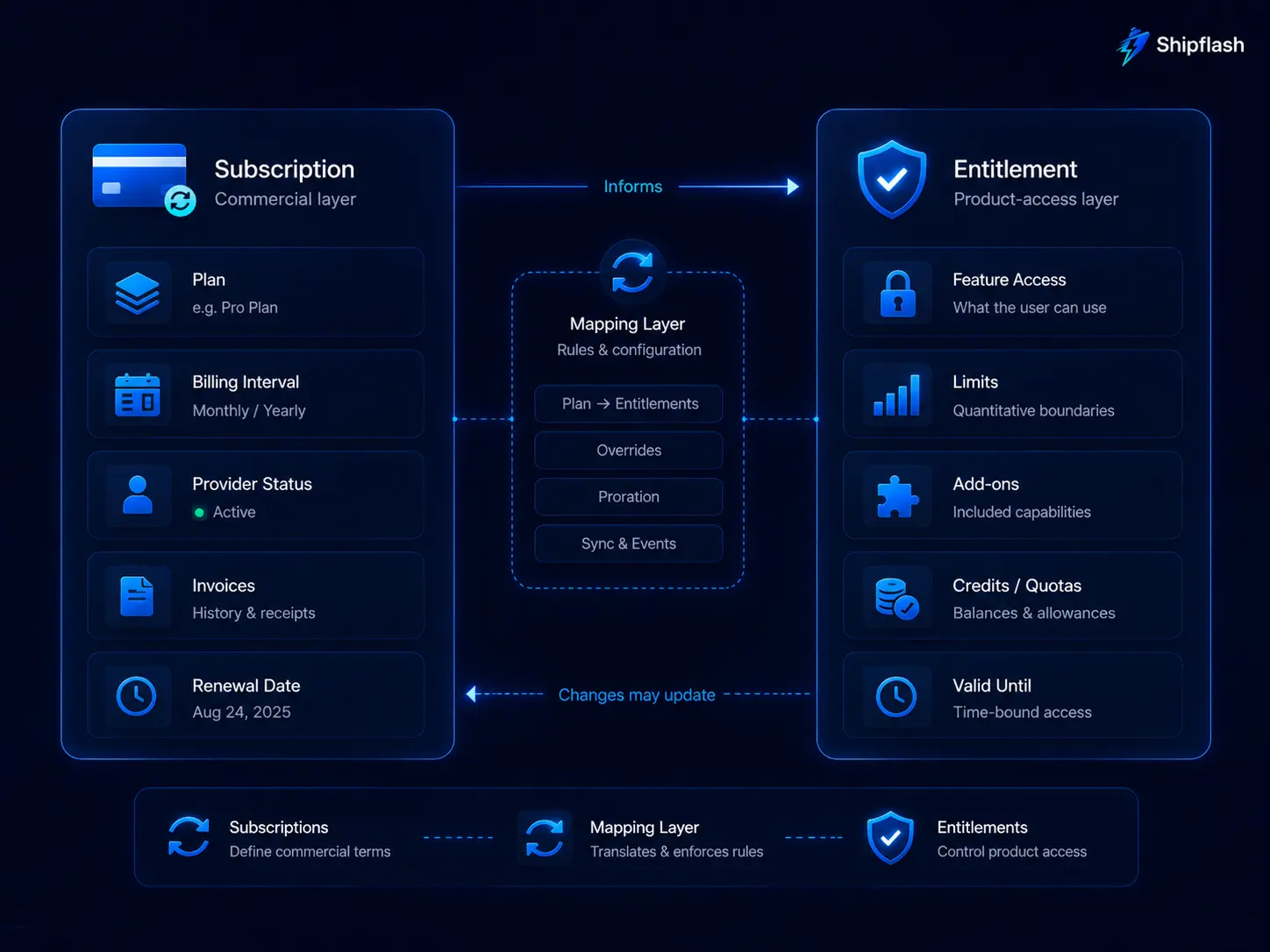
An entitlement is a product-level permission or limit granted to a customer.
A subscription is a commercial relationship with a billing provider.
They are related, but they are not identical.
Consider a Pro subscription. The provider may understand the product name, price, renewal date, and payment status. Your application may interpret it as:
- API access enabled,
- 25 team members,
- 100 GB of storage,
- 20,000 monthly automation runs,
- audit-log retention for one year,
- and priority support.
Those are entitlements.
Stripe now offers its own entitlement primitives and an Active Entitlement Summary event, which can be useful for provisioning features. Even when using provider-native entitlements, your application still needs a clear access contract and a reliable local read path for product authorization. Stripe’s entitlement documentation describes how product features can be associated with active customer entitlements.
Do not authorize features by checking a plan name
This pattern starts simple:
if (subscription.plan === "pro") {
  allowFeature();
}
It becomes fragile as soon as you add:
- grandfathered customers,
- custom enterprise packages,
- promotional access,
- trials,
- add-ons,
- usage limits,
- temporary support grants,
- lifetime purchases,
- or multiple providers.
A better access function asks for the capability itself:
const result = await entitlementService.check({
  accountId,
  feature: "advanced_analytics",
});

if (!result.allowed) {
  throw new ForbiddenError("Advanced analytics is not available.");
}
The result can contain more than a Boolean:
type EntitlementDecision = {
  allowed: boolean;
  reason:
    | "active_subscription"
    | "lifetime_purchase"
    | "trial"
    | "grace_period"
    | "manual_grant"
    | "limit_reached"
    | "expired"
    | "suspended"
    | "not_in_plan";
  limit?: number;
  used?: number;
  remaining?: number;
  validUntil?: string;
};
This produces better product behavior, clearer logs, and more useful customer-facing errors.
A practical entitlement record
An internal entitlement might contain:
| Field | Purpose |
|---|---|
| account_id | The customer or workspace receiving access |
| feature_key | Stable product capability |
| source_type | Subscription, purchase, credit pack, trial, or manual grant |
| source_id | The record that created the entitlement |
| granted | Whether access is currently enabled |
| limit_value | Optional quantitative limit |
| valid_from | Beginning of the access window |
| valid_until | Optional expiration |
| metadata | Provider-independent context |
| updated_at | Operational freshness |
Entitlements may be calculated dynamically or materialized into a table. Materialization is often useful because it creates a fast, inspectable representation of current access.
How to Build a Reliable Webhook Pipeline
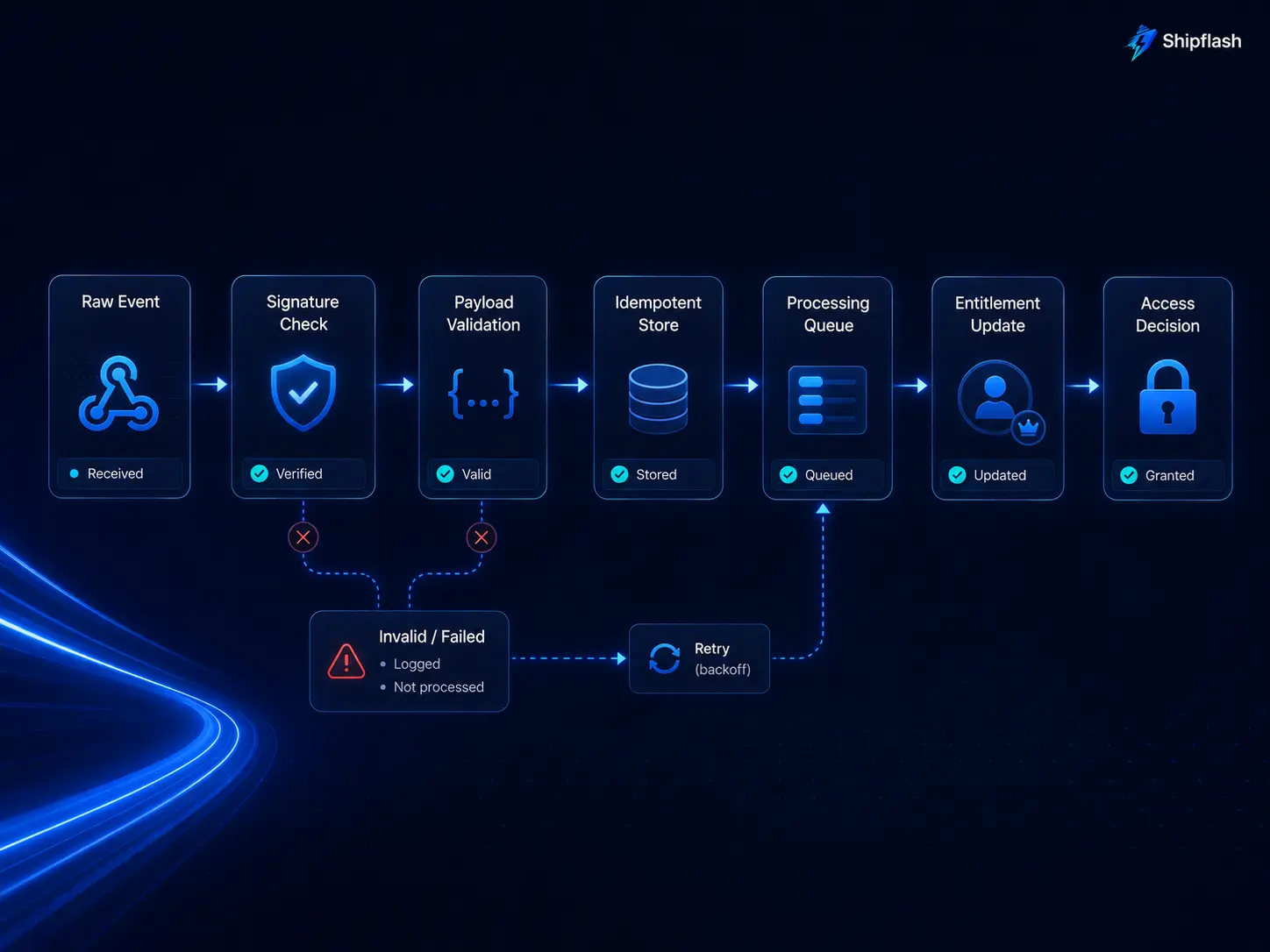
Webhooks are the synchronization channel between your provider and your application.
They are not ordinary API requests. They can be delayed, retried, duplicated, or delivered in an unexpected order. Your endpoint must treat those behaviors as normal rather than exceptional.
Stripe requires signature verification against the raw request body, may deliver duplicate events, and does not guarantee event ordering. Its documentation recommends keeping handlers independent of a specific arrival sequence and retrieving missing provider objects where necessary. Stripe’s webhook guide documents these delivery behaviors and verification requirements.
The recommended webhook sequence
A production webhook endpoint should:
- Read the exact raw request body.
- Read the provider signature headers.
- Verify the signature before trusting the event.
- Validate the payload shape and supported event type.
- Store the provider event ID under a unique constraint.
- Persist enough payload data for debugging or replay.
- Queue or perform the domain update.
- Record the processing result.
- Return an appropriate success response after durable acceptance.
The critical distinction is between receiving an event and successfully applying it.
An endpoint may accept the webhook, persist it, and return a success response while a background worker performs the slower business logic. The event record should show whether processing is pending, completed, rejected, or eligible for another attempt.
Example webhook event schema
create table billing_webhook_events (
  id uuid primary key default gen_random_uuid(),
  provider text not null,
  provider_event_id text not null,
  event_type text not null,
  provider_created_at timestamptz,
  payload jsonb not null,
  status text not null default 'received',
  processing_attempts integer not null default 0,
  last_error_code text,
  last_error_message text,
  received_at timestamptz not null default now(),
  processed_at timestamptz,
  next_attempt_at timestamptz,

  constraint billing_webhook_events_provider_event_unique
    unique (provider, provider_event_id)
);
The unique constraint is the foundation of webhook idempotency.
PostgreSQL’s INSERT ... ON CONFLICT can atomically avoid or update a row when a unique constraint is encountered. This is safer than performing a separate “does this event exist?” query followed by an insert, which can race under concurrent delivery. PostgreSQL documents this behavior in its INSERT reference.
A typical insert might look like this:
insert into billing_webhook_events (
  provider,
  provider_event_id,
  event_type,
  payload
)
values (
  $1,
  $2,
  $3,
  $4::jsonb
)
on conflict (provider, provider_event_id)
do nothing
returning id;
If no row is returned, the event has already been durably recorded.
Example Next.js webhook boundary
The following example is intentionally provider-neutral:
export async function POST(request: Request): Promise<Response> {
  const rawBody = await request.text();
  const headers = Object.fromEntries(request.headers.entries());

  let event: VerifiedBillingEvent;

  try {
    event = await billingProvider.verifyAndParseWebhook({
      rawBody,
      headers,
    });
  } catch {
    return Response.json(
      { error: "Invalid webhook signature" },
      { status: 401 },
    );
  }

  const accepted = await database.transaction(async (tx) => {
    const eventRecord = await tx.webhookEvents.insertIfAbsent({
      provider: event.provider,
      providerEventId: event.id,
      eventType: event.type,
      providerCreatedAt: event.createdAt,
      payload: event.raw,
    });

    if (!eventRecord) {
      return { duplicate: true };
    }

    await tx.billingOutbox.enqueue({
      webhookEventId: eventRecord.id,
      eventType: event.type,
    });

    return { duplicate: false };
  });

  return Response.json({
    received: true,
    duplicate: accepted.duplicate,
  });
}
This handler does not grant access directly. It verifies, stores, and queues the event.
The worker can process the normalized billing update separately without forcing the provider to wait for several database queries, email requests, analytics calls, or entitlement recalculations.
How to Handle Duplicate and Out-of-Order Events
How should duplicate webhooks be handled?
Store a stable provider event identifier under a database-level unique constraint. When the same event is delivered again, acknowledge it without repeating side effects. Do not rely only on an in-memory set because serverless instances restart and multiple instances may process requests concurrently.
Duplicate protection must cover more than the event row.
Suppose the event handler grants 1,000 credits. A retry must not create a second credit grant. The credit operation should therefore reference the webhook event or use its own idempotency key.
Good idempotency is layered:
Unique provider event
        ↓
Unique domain transition
        ↓
Unique ledger operation
        ↓
Safe notification or outbox delivery
Each side effect can then prove whether it has already occurred.
How should out-of-order events be handled?
Never assume that subscription.updated will arrive after subscription.created, or that a cancellation event will reach you after the final invoice event.
Use one or more of these strategies:
- compare the provider event timestamp with the last applied event,
- store provider object versions where available,
- retrieve the current object from the provider before applying a risky transition,
- make handlers upsert missing parent records,
- recalculate entitlements from current normalized state,
- and use reconciliation to correct unresolved drift.
Paddle explicitly documents at-least-once webhook delivery, possible out-of-order events, and periodic reconciliation as part of provisioning subscription access.
The important goal is not to reproduce every event in perfect chronological order. It is to reach the correct current state without repeating irreversible side effects.
How Subscription States Should Control Access
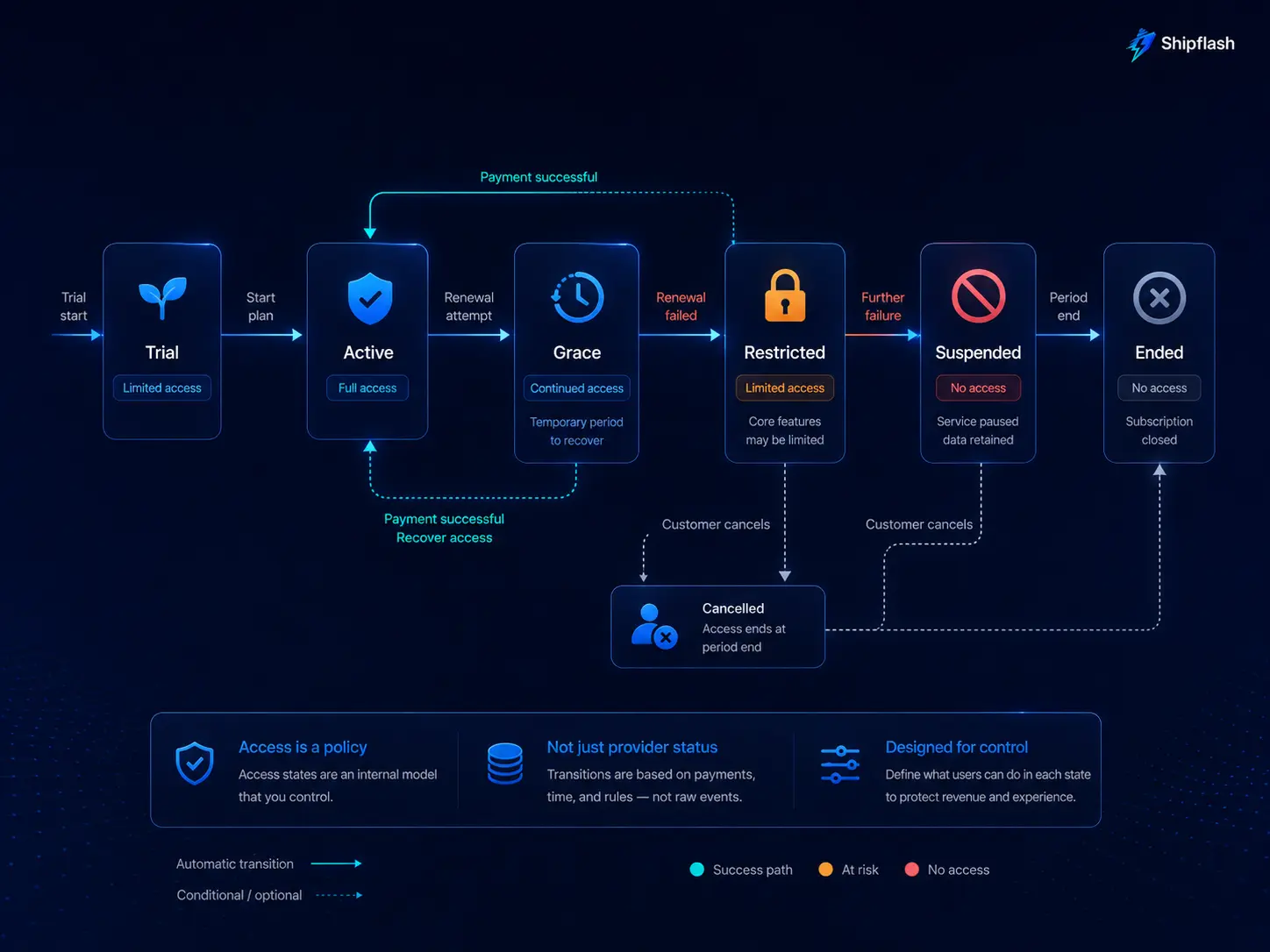
Provider statuses are integration details. Product access states should be defined in your own language.
A useful internal model might be:
| Internal state | Product interpretation |
|---|---|
| pending | Checkout or initial payment has not been confirmed |
| trial | Temporary access is active under trial rules |
| active | Paid access is available |
| grace | Payment needs attention, but access continues temporarily |
| restricted | Only selected capabilities remain available |
| suspended | Paid capabilities are blocked |
| ended | The commercial access period has finished |
| review | Refund, dispute, migration, or inconsistent state needs attention |
The provider adapter maps external statuses into this normalized model. The entitlement engine then applies the product’s policy.
Cancellation does not always mean immediate expiration
Many subscriptions are canceled at the end of the billing period.
When the provider reports that cancellation has been scheduled, your system should preserve access until the actual paid-through date unless the business intentionally promises something different.
Store both:
- the cancellation intention, and
- the effective access end date.
Otherwise, a customer who cancels future renewal may lose access to time they already purchased.
A failed payment needs a deliberate grace policy
Immediately revoking every feature after one failed renewal often creates a poor customer experience. Cards expire, banks decline legitimate charges, and retry systems may recover the payment.
A mature access policy can introduce stages:
Payment fails
    ↓
Grace period begins
    ↓
Customer receives recovery instructions
    ↓
Expensive or abuse-sensitive operations may be limited
    ↓
Payment succeeds → restore active access
    ↓
Retries exhausted → suspend or end access
The exact policy depends on product cost and risk.
A low-cost collaboration tool may preserve most access for several days. A product that incurs large third-party API costs may disable new consumption while preserving read-only access.
Refunds and disputes require separate policies
A refund changes a financial transaction. It does not automatically explain what should happen to every product entitlement.
For a one-time lifetime purchase, a full refund will usually revoke the associated lifetime grant. A partial refund may require a manual decision unless the offer was explicitly divisible.
For credits, your application needs to know:
- how many credits were granted,
- how many have already been consumed,
- whether unused credits should be revoked,
- whether the balance is allowed to become negative,
- and how the adjustment will appear in the ledger.
Disputes may justify temporary suspension, but irreversible deletion is usually risky while the dispute remains unresolved.
Treat refunds and disputes as first-class billing events instead of forcing them through subscription cancellation logic.
Usage-Based Billing and Prepaid Credits
Usage billing introduces a second consistency problem: the provider and your application must agree not only about subscriptions, but also about consumption.
Usage events should be immutable and idempotent
Record each billable event with a unique event ID:
type UsageEvent = {
  id: string;
  accountId: string;
  meterKey: string;
  quantity: number;
  occurredAt: string;
  dimensions?: Record<string, string>;
  sourceRequestId?: string;
};
An event should not be counted twice because a client retried a request or a background job restarted.
Avoid using a mutable monthly counter as the only usage record. A counter is useful as a projection, but immutable events make it possible to audit, recalculate, and reconcile totals.
Separate product usage from provider reporting
Your product owns the definition of a usage event. The provider owns invoice calculation after usage has been reported.
A reliable sequence is:
- Validate the customer and entitlement.
- Perform or reserve the product operation.
- Record the internal usage event.
- Update the internal usage projection.
- Add an outbox record for provider reporting.
- Send usage to the provider.
- Record the provider acknowledgement.
- Reconcile unreported or mismatched events.
This prevents a temporary provider outage from blocking every product request.
Credits need a ledger, not only a balance
A single credit_balance column cannot explain how the balance was created or changed.
Use an append-only credit ledger containing entries such as:
- grant,
- consumption,
- expiration,
- refund revocation,
- promotional adjustment,
- support adjustment,
- and migration correction.
The current balance becomes the sum of valid ledger entries.
This provides an audit trail and allows each mutation to carry an idempotency key. It also makes partial refunds and expired grants far easier to reason about.
Why Every Billing System Needs Reconciliation
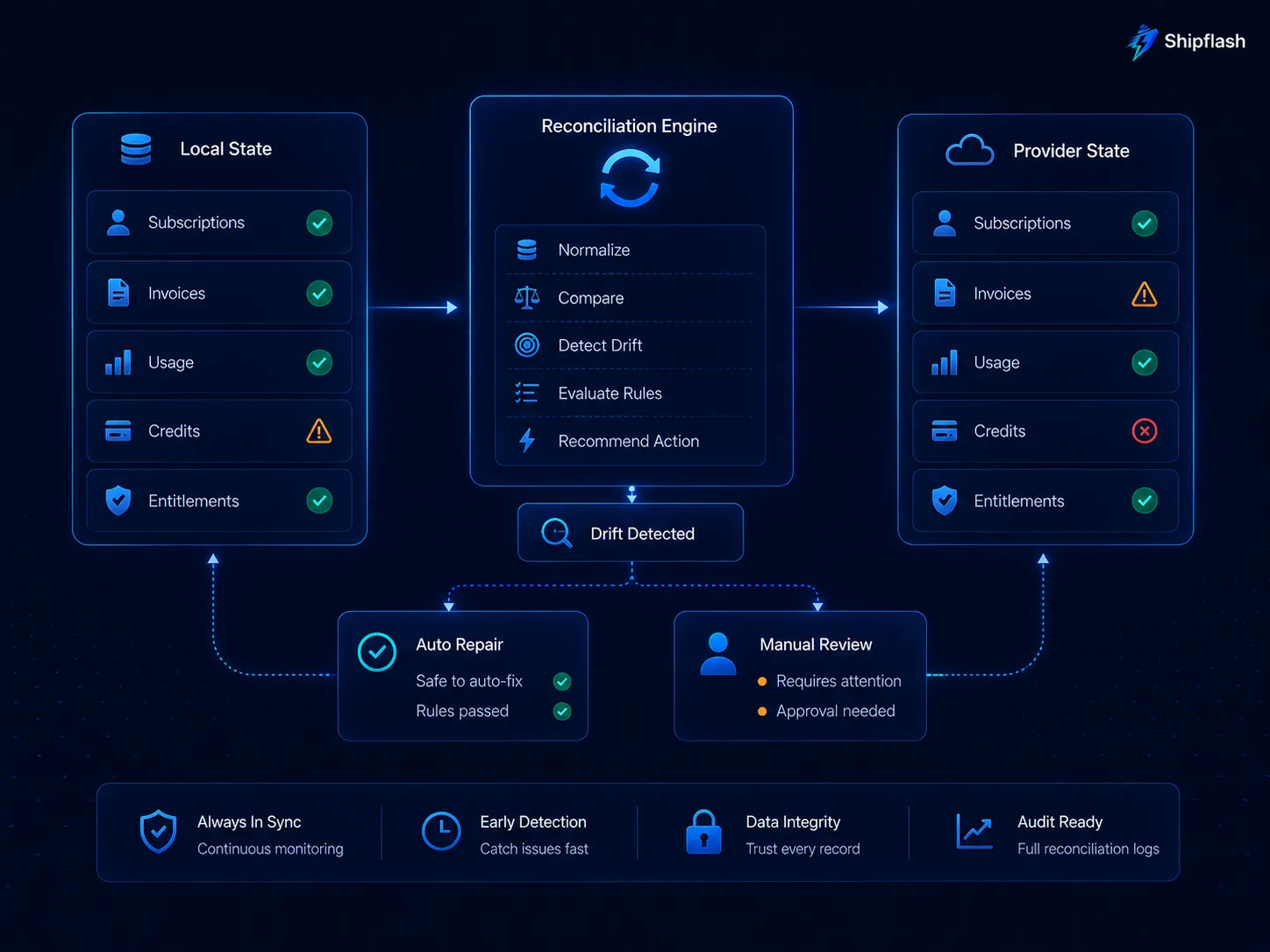
Webhooks are the primary synchronization path. Reconciliation is the safety net.
A webhook can be missed because your application was unavailable, a deployment failed, a handler contained a bug, the provider exhausted its retries, or an operator manually changed something in the provider dashboard.
Even a reliable webhook implementation should assume that drift will eventually occur.
What is billing reconciliation?
Billing reconciliation is a scheduled process that compares local billing records with the provider’s current state. It identifies missing events, stale subscriptions, incorrect renewal dates, unmatched transactions, unreported usage, and entitlement differences, then repairs safe cases or sends ambiguous ones for operator review.
A reconciliation job can check:
| Check | Example mismatch |
|---|---|
| Customer linkage | Provider customer exists but no local account is linked |
| Subscription status | Provider says active while local state says ended |
| Renewal date | Local access ends before the paid-through date |
| Product mapping | Provider price cannot be mapped to the internal catalog |
| Invoice state | Provider invoice is paid but local purchase is missing |
| Usage reporting | Internal event has never reached the provider |
| Credits | Refunded grant remains spendable |
| Entitlements | Current access does not match the applicable catalog package |
Reconciliation should distinguish repairable and ambiguous drift
Some differences can be repaired automatically.
For example, if the provider reports a newer subscription renewal date and the local record is clearly stale, the application can update the projection and recalculate access.
Other situations need review:
- two local accounts claim the same provider customer,
- an unknown provider price appears,
- a partial refund has no matching internal policy,
- consumed credits exceed a refunded grant,
- or an operator manually changed a subscription outside the expected workflow.
A useful finding record contains:
type ReconciliationFinding = {
  provider: string;
  accountId?: string;
  category: string;
  severity: "info" | "warning" | "critical";
  localState: unknown;
  providerState: unknown;
  detectedAt: string;
  resolution: "pending" | "auto_repaired" | "ignored" | "manual_review";
  repairDetails?: unknown;
};
Reconciliation should be observable and repeatable. A silent scheduled script that modifies customer access without leaving evidence creates a new operational risk.
Designing a Payment Provider Abstraction
Provider abstraction should normalize the capabilities your product actually needs. It should not attempt to hide every difference between payment platforms.
Stripe, Lemon Squeezy, Paddle, and Dodo Payments all provide webhook-based synchronization, but their event names, payloads, signing headers, retry behavior, customer models, and available billing capabilities differ.
Their official documentation illustrates these differences:
Lemon Squeezy recommends storing webhook events locally so the endpoint can respond quickly and processing can continue outside the request. It also signs events using the request body and an X-Signature header. Dodo Payments documents unique webhook IDs for idempotency, signed payload verification, and the possibility of out-of-order delivery.
Normalize business operations, not raw provider objects
A useful adapter contract might expose:
interface BillingProvider {
  createCheckout(
    input: CheckoutInput,
  ): Promise<CheckoutResult>;

  createCustomerPortal(
    input: PortalInput,
  ): Promise<PortalResult>;

  verifyAndParseWebhook(
    input: WebhookInput,
  ): Promise<VerifiedBillingEvent>;

  retrieveCustomer(
    providerCustomerId: string,
  ): Promise<NormalizedCustomer>;

  retrieveSubscription(
    providerSubscriptionId: string,
  ): Promise<NormalizedSubscription>;

  listReconciliationState(
    cursor?: string,
  ): Promise<ProviderStatePage>;

  capabilities(): BillingProviderCapabilities;
}
The adapter translates provider details into normalized domain records. It should not leak raw provider statuses throughout the entire application.
Raw payloads can still be stored for auditing and debugging. The difference is that product code consumes a stable internal contract.
Capabilities should be explicit
Not every provider supports every billing model or administrative workflow.
Represent support directly:
type BillingProviderCapabilities = {
  recurringSubscriptions: boolean;
  oneTimePurchases: boolean;
  meteredUsage: boolean;
  prepaidCredits: boolean;
  customerPortal: boolean;
  refundsApi: boolean;
  disputes: boolean;
  invoiceExport: boolean;
  nativeEntitlements: boolean;
};
When a feature is unsupported, fail during configuration or administration. Do not wait until a customer attempts to purchase an incompatible package.
This architecture also helps avoid over-coupling your product to the tool that created the first prototype. The trade-off between closed AI builders and an owned foundation is explored further in AI App Builder vs. SaaS Boilerplate.
Securing Billing Data and Access Decisions
Authentication proves who the user is. Billing authorization decides whether that user or account may perform a paid operation.
The browser should never be the final authority.
A hidden button, disabled form, plan name in local storage, or client-side React condition can improve the interface, but it cannot protect a server action or database row.
OWASP recommends deny-by-default authorization and validating permissions on every request. This is especially important for paid capabilities because a single unprotected API route can bypass the product’s entire pricing model. The OWASP Authorization Cheat Sheet provides broader guidance on consistent access enforcement.
Enforce entitlement checks at the protected boundary
A paid operation should validate:
- the authenticated identity,
- account or workspace membership,
- the user’s role,
- the current product entitlement,
- the applicable usage limit,
- and ownership of the target resource.
Do not collapse all six questions into “the user has a Pro subscription.”
Use database authorization as defense in depth
When billing tables or protected resources are exposed through Supabase APIs, Row Level Security can enforce tenant isolation at the database layer.
Supabase recommends enabling RLS for tables in exposed schemas and granting only the permissions each Postgres role requires. Service-role credentials bypass normal RLS protections and must never be exposed in the browser. Supabase’s Row Level Security guide covers policy behavior, role grants, service access, and indexing considerations.
An entitlement table policy might ensure that authenticated customers can read only the grants belonging to their account:
create policy "Members can read account entitlements"
on account_entitlements
for select
to authenticated
using (
  exists (
    select 1
    from account_memberships
    where account_memberships.account_id =
      account_entitlements.account_id
      and account_memberships.user_id =
        (select auth.uid())
  )
);
Administrative writes should use narrow server-side operations rather than broad client permissions.
Testing a Production Billing Integration
A test checkout is not enough.
The billing system must be tested as a state machine operating under retries, concurrency, delayed events, and partial failure.
| Test layer | What it should prove |
|---|---|
| Unit tests | Status mapping, entitlement calculation, refund policy |
| Provider contract tests | Raw payloads normalize into expected domain events |
| Database tests | Unique constraints and transactions prevent duplication |
| Integration tests | Verified webhooks update projections and entitlements |
| Authorization tests | Unentitled users cannot call protected operations |
| End-to-end tests | Checkout, renewal, cancellation, and portal flows work |
| Replay tests | The same webhook can be processed repeatedly without duplication |
| Ordering tests | Events arriving in different sequences converge correctly |
| Reconciliation tests | Drift is detected and safe repairs are applied |
| Failure tests | Provider outages and queue failures do not corrupt access |
Test the negative paths
The most valuable tests often prove what must not happen:
- an invalid signature must not create a purchase,
- a duplicate event must not grant credits twice,
- a canceled-at-period-end subscription must not expire early,
- a user from one workspace must not read another workspace’s billing data,
- an unknown price must not silently grant the default plan,
- a failed reconciliation job must not mark itself successful,
- and a refunded purchase must not leave an unexplained entitlement active.
Keep real provider fixtures
Store sanitized payload fixtures for the event types you support. These fixtures protect your adapter against accidental assumptions about nesting, nullable fields, metadata, and lifecycle transitions.
Provider API versions can change the event structure. Pin expected versions where possible and review upgrade changes deliberately.
AI coding tools can help generate fixtures and test cases, but the domain rules still need human review. A safe repository workflow for planning, testing, and reviewing AI-assisted changes is covered in Claude Code for SaaS.
Billing Observability and Admin Operations
Reliable billing cannot be operated through application logs alone.
When a customer reports missing access, an operator should be able to answer:
- Which account is linked to the provider customer?
- What did the customer buy?
- Which provider events were received?
- Did signature verification pass?
- Which handlers ran?
- Which event last changed the subscription?
- What entitlement is currently active?
- Was a refund or dispute received?
- Did reconciliation find drift?
- Can the failed event be retried safely?
Important billing metrics
A useful operational dashboard may include:
| Metric | Why it matters |
|---|---|
| Webhook verification failures | Detects configuration problems or suspicious traffic |
| Duplicate event count | Shows provider retries and confirms deduplication is active |
| Processing latency | Reveals growing queue or database delays |
| Failed event count | Highlights unprocessed billing changes |
| Oldest pending event | Measures how far synchronization is behind |
| Reconciliation drift count | Reveals persistent inconsistency |
| Unknown catalog mappings | Detects provider configuration mistakes |
| Entitlement recalculation failures | Exposes access-control risk |
| Unreported usage events | Identifies potential revenue leakage |
| Negative credit balances | Reveals accounting or refund-policy failures |
Logs should include stable identifiers such as:
- request ID,
- provider event ID,
- provider customer ID,
- provider subscription ID,
- internal account ID,
- entitlement source ID,
- and reconciliation run ID.
Do not log complete secrets, payment details, or unnecessary personal information.
Build safe operator actions
Administrative controls may include:
- replay a failed event,
- retrieve the latest provider object,
- recalculate entitlements,
- rerun reconciliation for one account,
- attach an unlinked provider customer,
- resolve an unknown catalog mapping,
- and add a documented manual grant.
Every operator action should require authorization and leave an audit record.
Common SaaS Billing Architecture Mistakes
| Mistake | Why it fails | Better approach |
|---|---|---|
| Granting access from the checkout redirect | The client redirect is not reliable proof of payment | Wait for a verified server event or provider API confirmation |
| Checking only plan === "pro" | Cannot represent trials, add-ons, custom plans, or grace periods | Authorize against feature-level entitlements |
| Processing webhooks without a unique event constraint | Retries can repeat grants, notifications, or ledger mutations | Deduplicate at the database level |
| Parsing JSON before signature verification | Body transformations can invalidate or weaken verification | Preserve and verify the raw request body |
| Assuming events arrive in order | Networks and retry systems do not preserve business sequence | Compare event freshness and retrieve current provider state |
| Revoking access immediately on cancellation | Customers may have paid time remaining | Use the effective period end |
| Storing only a credit balance | There is no audit trail for grants, usage, or refunds | Maintain an append-only credit ledger |
| Calling the provider during every feature request | Adds latency and creates an external availability dependency | Read a local entitlement projection |
| Relying only on webhooks | Missed or broken events create permanent drift | Run scheduled reconciliation |
| Hiding paid features only in the UI | Attackers can call the underlying endpoint directly | Enforce authorization on every protected server request |
| Hardcoding provider price IDs throughout the app | Pricing changes require risky code edits | Use stable internal catalog keys |
| Treating all providers as identical | Unsupported capabilities fail late and unpredictably | Publish an explicit capability contract |
Many of these mistakes appear when a fast prototype is pushed into production without revisiting its assumptions. The transition from generated demo to maintainable product is explored in Vibe Coding a SaaS: From Prototype to Production.
A Practical Implementation Roadmap
You do not need to implement every advanced billing feature before the first sale. You do need foundations that let you add complexity without rewriting access control.
Phase 1: Define the commercial model
Write down:
- what customers purchase,
- whether access is recurring or permanent,
- which features are included,
- how cancellations work,
- how failed payments affect access,
- and how refunds affect entitlements.
Ambiguity here becomes code inconsistency later.
Phase 2: Create the internal catalog
Introduce stable product and price keys. Map provider identifiers at the catalog boundary rather than distributing them throughout the codebase.
Reject unknown or inactive catalog items before checkout creation.
Phase 3: Separate provider records from product access
Create local customer, purchase, subscription, and invoice projections.
Then create an entitlement function or table that answers product access questions without requiring a live provider request.
Phase 4: Harden webhook ingestion
Implement:
- raw-body signature verification,
- strict payload validation,
- database event deduplication,
- processing status,
- retry metadata,
- structured errors,
- and safe acknowledgement behavior.
Test duplicate and invalid events before enabling production checkout.
Phase 5: Encode lifecycle policies
Define explicit rules for:
- trials,
- activation,
- renewal,
- scheduled cancellation,
- immediate cancellation,
- grace periods,
- suspension,
- refunds,
- disputes,
- and reactivation.
Avoid allowing each page or API route to interpret provider statuses independently.
Phase 6: Add reconciliation
Start with the records that directly affect access:
- active subscriptions,
- recent payments,
- one-time purchases,
- refunded transactions,
- and current entitlements.
Run it on a schedule and create reviewable findings.
Phase 7: Add usage and credits only when needed
When the product needs metering, add immutable usage events and provider-reporting outboxes.
When it needs prepaid credits, add a ledger rather than extending the subscription table with another mutable number.
Phase 8: Build operational visibility
Add event inspection, account billing history, entitlement explanations, reconciliation findings, and authorized repair actions.
The goal is not a large dashboard. It is the ability to diagnose a customer access problem without reading raw production tables.
How Shipflash Approaches the Billing Foundation
Shipflash is designed around the idea that billing is a product system, not a checkout component.
Its billing foundation is structured to keep provider integration details separate from internal customer, purchase, subscription, usage, credit, and entitlement records. Verified webhook processing, local billing projections, provider adapters, access-aware product flows, testing, and operational visibility give founders a clearer starting point than connecting a payment button to a plan string.
Shipflash does not remove the need to define your pricing, refund policy, usage rules, and customer lifecycle. Those decisions are specific to your product.
It provides an organized place to implement them without rebuilding the entire surrounding foundation for every SaaS.
Frequently Asked Questions
What are the essential components of SaaS billing architecture?
The essential components are a product catalog, provider state projection, entitlement engine, verified webhook pipeline, event history, usage or credit records, reconciliation process, and server-side access control. Together, these components connect payment activity to reliable product authorization.
Should Stripe or my database be the source of truth?
Stripe should remain authoritative for Stripe-owned financial facts such as charges, invoices, refunds, and subscription periods. Your database should maintain the local operational projection and product-specific entitlements used for fast access decisions. Reconciliation keeps the two consistent.
Should my application call the payment provider before every paid request?
Usually, no. Store and update a local entitlement projection through webhooks and reconciliation. Calling the provider for every request adds latency, introduces rate-limit concerns, and makes product availability depend on a remote billing API.
How do I prevent duplicate webhook processing?
Store the provider event ID under a database unique constraint and make every downstream side effect idempotent. Credit grants, entitlement transitions, emails, and usage updates should each be able to determine whether the same operation has already been applied.
What is the difference between a subscription and an entitlement?
A subscription describes the commercial agreement with the billing provider. An entitlement describes what the customer may use inside your product. One subscription may produce many feature entitlements, limits, add-ons, or temporary access rules.
Why do I need reconciliation if webhooks are enabled?
Webhooks can be missed, delayed, delivered out of order, or processed incorrectly. Reconciliation periodically compares local records with current provider data and repairs or reports drift that the real-time webhook path did not resolve.
Should failed payments immediately remove access?
Not necessarily. Define a grace-period policy based on your operating cost, abuse risk, and customer experience. Many SaaS products temporarily preserve access or switch the account to a restricted mode while the provider retries payment.
How should prepaid credits be stored?
Use an append-only ledger containing grants, consumption, expiration, refunds, and adjustments. Calculate the current balance from valid ledger entries or a verified projection. Do not rely only on a mutable balance column.
Conclusion
A reliable SaaS billing architecture is not built around checkout. It is built around controlled state transitions.
The payment provider processes money. Webhooks communicate external changes. Your database stores a durable operational projection. Entitlements translate commercial state into product access. Usage and credit ledgers explain consumption. Reconciliation detects whatever the real-time path missed.
The strongest design is not the one with the most billing code. It is the one where every responsibility is clear:
- the catalog defines what was sold,
- the provider records what happened financially,
- the event history proves what was received,
- the entitlement layer decides what is allowed,
- and reconciliation confirms that the systems still agree.
When these boundaries are established early, pricing changes, provider migrations, refunds, usage billing, and customer support become manageable extensions instead of recurring architectural emergencies.
That is the difference between adding payments to a prototype and building billing that a real SaaS can safely operate.