
Building a SaaS product is rarely difficult because of the first feature.
The difficulty begins when that feature must coexist with authentication, authorization, billing, account management, emails, webhooks, admin tools, database policies, deployment environments, and production failures.
A login page can be built in an afternoon. A trustworthy authentication system also needs protected routes, session handling, account recovery, authorization boundaries, database access policies, and predictable behavior when something goes wrong.
The same pattern appears throughout a SaaS product. Checkout is only the visible part of billing. Behind it sit subscription states, webhook retries, duplicate events, cancelled subscriptions, refunds, customer portals, reconciliation, and access control.
This is why serious SaaS development needs more than a collection of prebuilt screens. It needs a production-ready foundation.
What is a production-ready SaaS foundation?
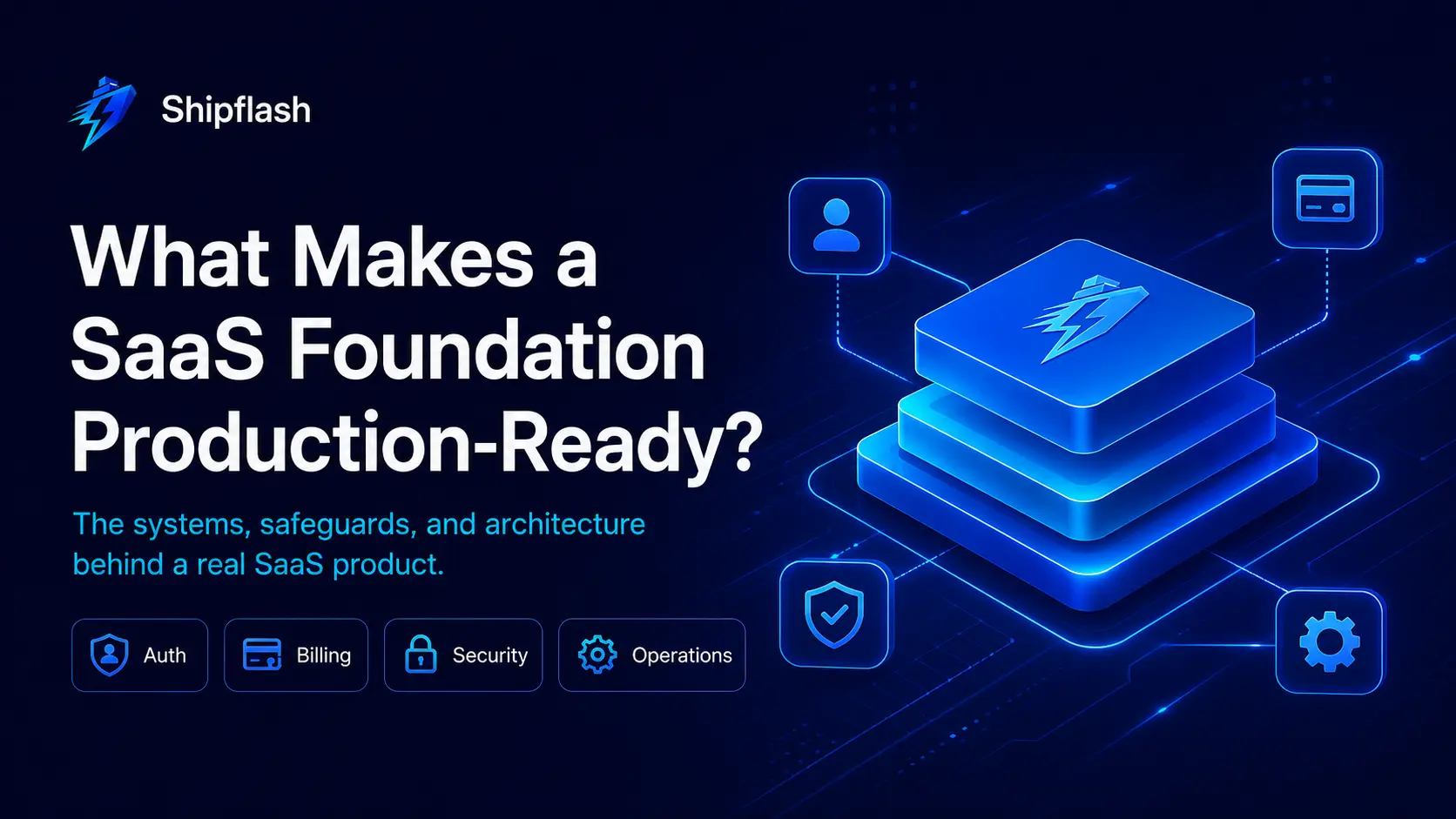
A production-ready SaaS foundation is a reusable application base that already includes the essential systems, security boundaries, operational safeguards, and development conventions required to build and run a real SaaS product.
It normally includes:
- Authentication and account recovery
- User and administrative authorization
- Secure database access
- Billing and entitlement management
- Reliable webhook processing
- Transactional email infrastructure
- Product settings and content management
- Error handling and observability
- Automated testing
- Deployment configuration
- Documentation for future development
The word “foundation” matters. It should give developers a stable base without forcing every future product into one rigid shape.
A good foundation handles repetitive infrastructure while leaving the actual product, customer experience, and business rules under the founder’s control.
SaaS foundation versus SaaS boilerplate
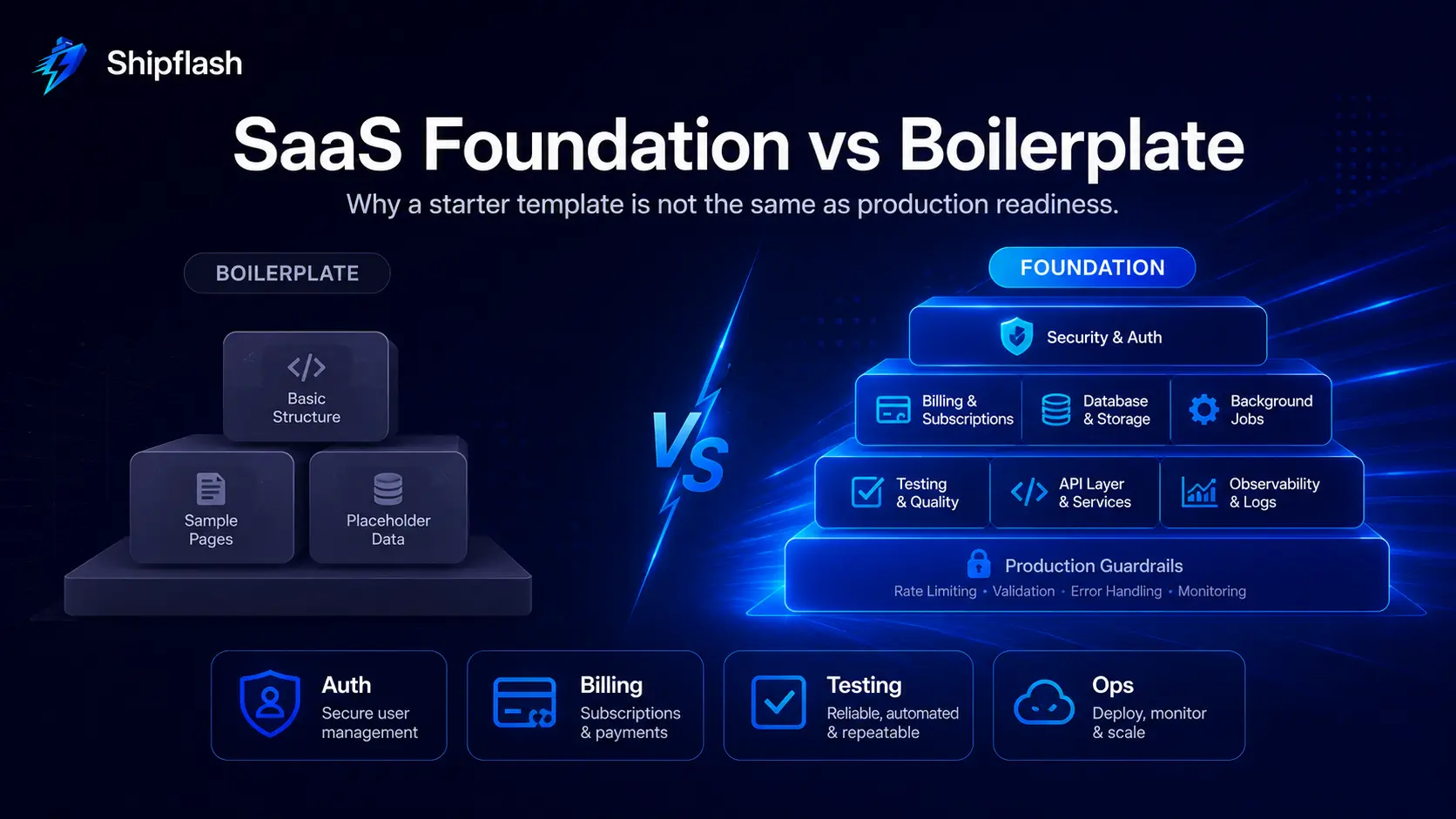
The terms are often used interchangeably, but they do not always describe the same level of readiness.
| Area | Basic boilerplate | Production-ready foundation |
|---|---|---|
| Authentication | Login and registration screens | Complete session, recovery and authorization flows |
| Database | Example tables | Migrations, constraints, policies and generated types |
| Billing | Checkout button | Lifecycle states, webhooks, retries and entitlements |
| Security | Route protection | Application and database-level access control |
| Testing | A few component tests | Critical-path unit, integration and end-to-end coverage |
| Operations | Basic deployment file | Logging, request tracing, health checks and failure handling |
| Documentation | Installation notes | Architecture, extension points and operational guidance |
| Maintainability | Shared starter files | Clear module and ownership boundaries |
A boilerplate may help someone create the first page faster. A foundation should also reduce the risk of the hundredth change.
That difference becomes important once customers are paying, multiple developers are contributing, or AI coding tools are modifying several parts of the application at once.
The four layers of a reliable SaaS foundation
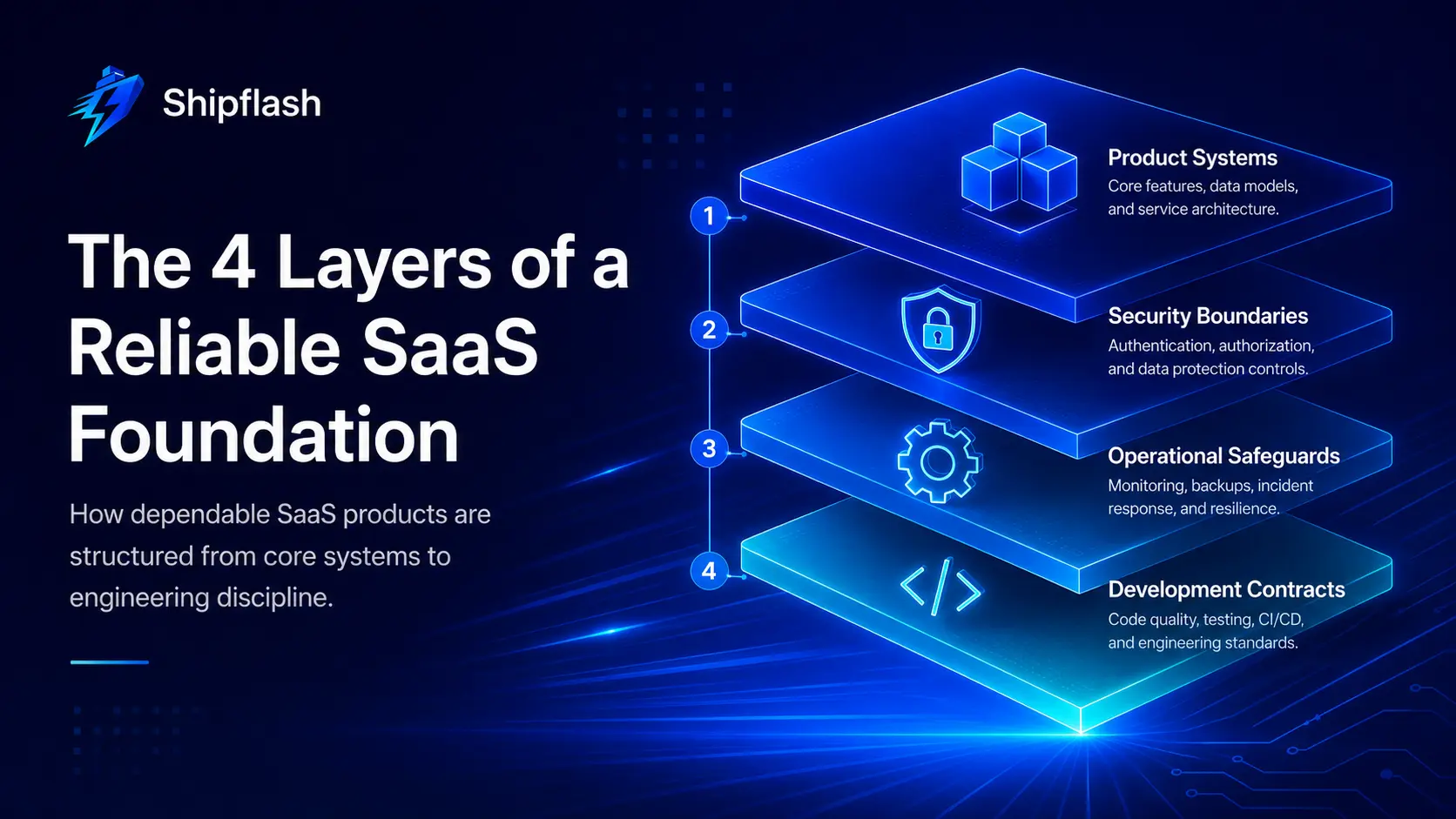
A dependable SaaS application can be understood through four connected layers.
1. Product systems
These are the capabilities customers and operators interact with directly:
- Authentication
- Customer accounts
- Billing
- Notifications
- Settings
- Content
- Administration
- Analytics
These modules create visible product value, but they cannot operate safely without the remaining layers.
2. Security boundaries
Security cannot depend entirely on whether a page is hidden or whether a server action remembers to check a role.
Authorization should exist at every meaningful boundary:
- Page and route access
- Server actions
- API endpoints
- Database queries
- Administrative operations
- Webhook handlers
- Background jobs
Supabase combines authentication with PostgreSQL Row Level Security, allowing database policies to control which rows an authenticated user may access. RLS can provide an additional layer of protection even when data is accessed through third-party tools or an application path behaves unexpectedly. remove the need for application-level checks. It creates defense in depth: the interface, server and database each enforce the boundaries they own.
3. Operational safeguards
Production systems fail in ordinary ways.
A provider sends the same webhook twice. A network request times out after the payment has already succeeded. An email provider becomes unavailable. A background job stops halfway through its work. A user refreshes a page while a mutation is still processing.
A reliable foundation expects these events rather than treating them as unlikely exceptions.
That means implementing:
- Idempotent operations
- Unique event identifiers
- Retry-safe background jobs
- Request identifiers
- Structured logs
- Input-size limits
- Explicit error states
- Reconciliation processes
- Fail-closed authorization
- Health and readiness checks
Stripe recommends idempotency keys for safely retrying API operations without accidentally repeating the underlying action. Its webhook system also delivers asynchronous events that applications must process reliably. may change, but the engineering principle remains the same: external events must be treated as untrusted, repeatable and potentially out of order.
4. Development contracts
The final layer protects the maintainability of the codebase.
Development contracts define how the product should be extended. They may include:
- Module boundaries
- Naming conventions
- Validation rules
- Type-safety requirements
- Database migration practices
- Testing expectations
- Approved dependency patterns
- Environment-variable contracts
- Documentation requirements
- Continuous-integration checks
Without these contracts, a starter repository gradually becomes a collection of exceptions. Every new feature chooses a different folder, validation library, error format or data-access pattern.
Consistency is not cosmetic. It lowers the amount of context a developer—or an AI coding assistant—must reconstruct before making a safe change.
Why Next.js and Supabase work well for SaaS products
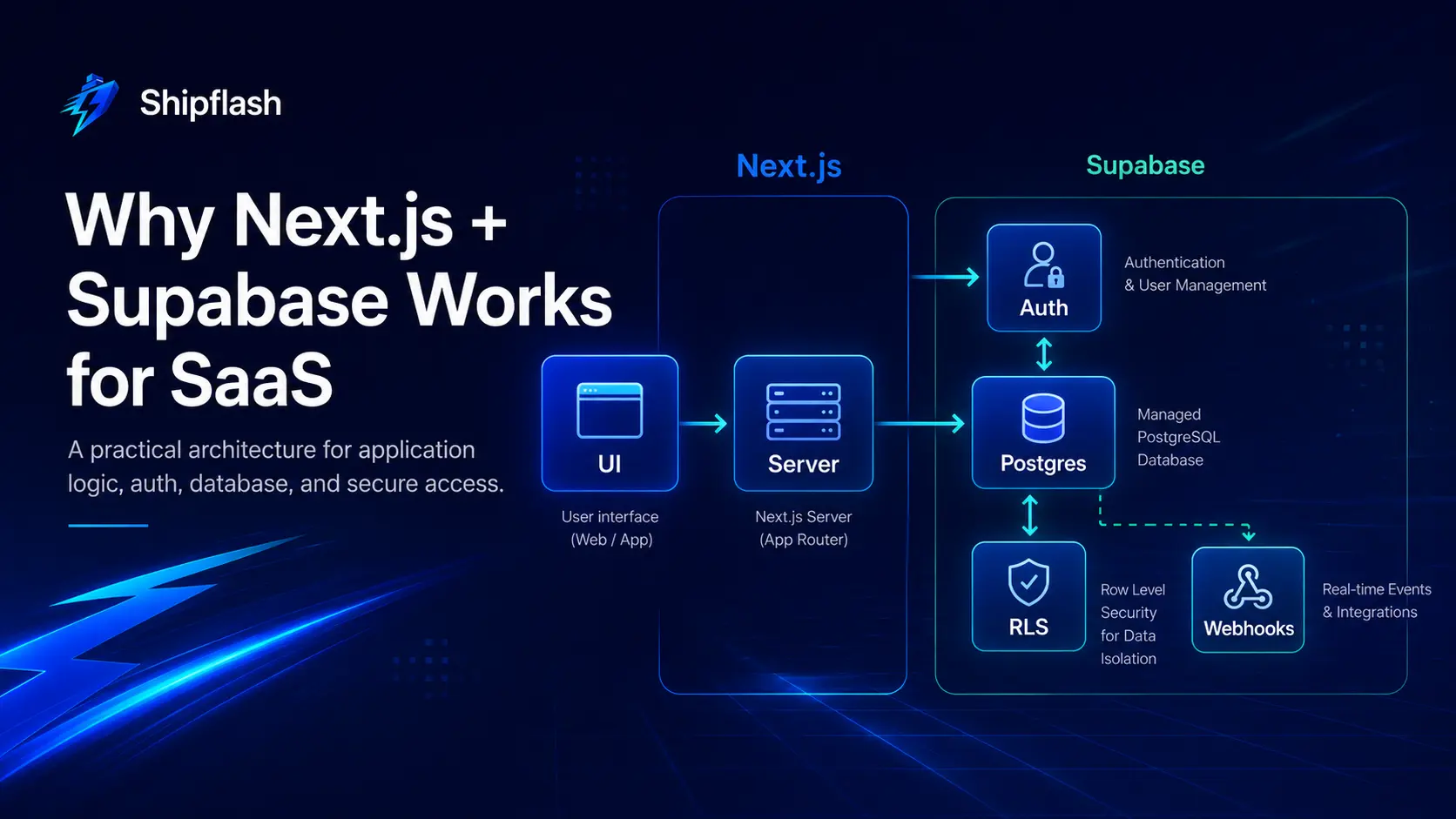
Next.js and Supabase cover different parts of the application while fitting into a common TypeScript workflow.
Next.js provides application routing, server and client components, metadata handling, route handlers, error boundaries, caching, and deployment patterns through its App Router. ides PostgreSQL, authentication, storage and database-level authorization through Row Level Security.
Together, they support a useful division of responsibility:
| Responsibility | Primary owner |
|---|---|
| Pages and user interface | Next.js |
| Server-rendered application logic | Next.js |
| API and webhook endpoints | Next.js route handlers |
| Authentication identity | Supabase Auth |
| Persistent application data | PostgreSQL |
| Row-level authorization | Supabase RLS |
| Database integrity | Constraints, grants and migrations |
However, choosing these technologies does not automatically produce good architecture.
A maintainable implementation must still answer several questions:
- Where does domain logic live?
- Which operations require server-only access?
- How are provider payloads validated?
- How are database errors translated?
- Which modules may access elevated credentials?
- How are billing entitlements calculated?
- How do tests run without depending on production services?
The framework provides capabilities. The foundation must provide conventions.
The Four Parts of a Production-Ready SaaS Billing Architecture
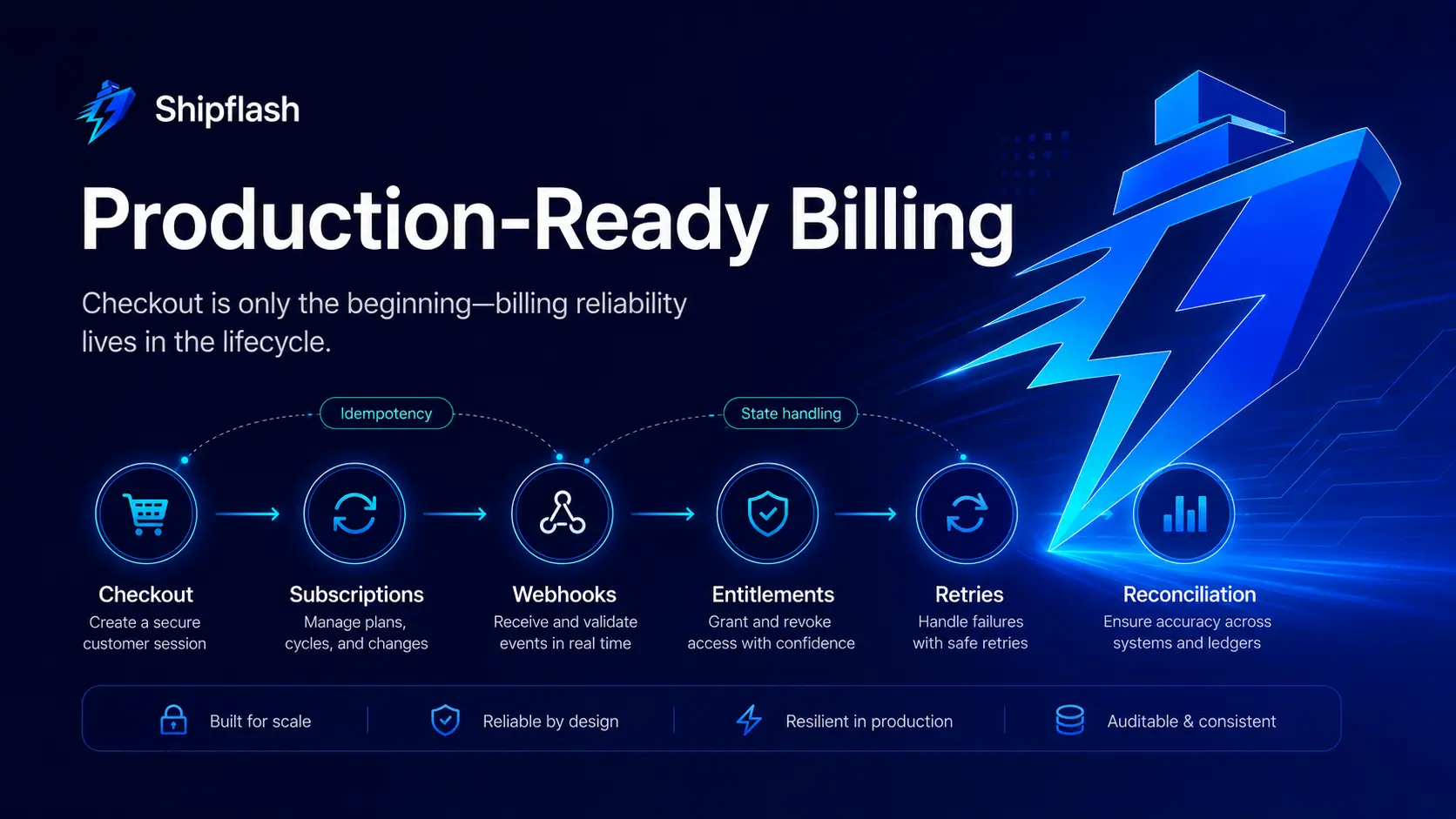
A production-ready SaaS billing system should not treat the payment provider as the product’s only source of truth.
Stripe, Lemon Squeezy, Paddle, Dodo Payments, or another provider can tell the application what happened financially. However, the provider does not fully understand the product’s internal access rules, feature limits, credit balances, account relationships, or customer experience.
A reliable SaaS billing architecture separates four responsibilities:
- Product catalog
- Provider state
- Internal entitlements
- Billing event history
Together, these layers create a billing system that is easier to understand, test, reconcile, and extend.
1. Product Catalog: What Can the Customer Purchase?
The product catalog defines the commercial offers available to customers and the rules attached to each offer.
It may include:
- Monthly and yearly subscriptions
- One-time lifetime-access products
- Usage-based plans
- Prepaid credit packages
- Free trials
- Hybrid plans with a base fee and additional usage
- Product variants for different customer segments
- Promotional or grandfathered pricing
- Add-ons and optional features
A catalog entry should describe more than the payment provider’s price identifier. It should also capture the business meaning of the offer.
For example, a SaaS plan may need to define:
- The plan name shown to customers
- Billing frequency
- Supported currency
- Trial duration
- Included features
- Usage limits
- Credit grants
- Upgrade and downgrade behavior
- Whether the offer is publicly available
- Which payment providers support it
- Which internal entitlement it activates
This distinction is important because a provider price ID is only an external identifier. It does not explain what the customer receives.
A product such as pro-yearly may point to one price in Stripe and another in a merchant-of-record provider, while still activating the same internal Pro entitlement.
The product catalog should therefore act as the translation layer between the commercial offer and the provider-specific price.
2. Provider State: What Has the Payment Provider Reported?
Provider state records the financial and lifecycle information received from the payment platform.
This may include:
- Provider customer ID
- Subscription ID
- Order or transaction ID
- Invoice ID
- Product and price identifiers
- Subscription status
- Billing interval
- Current billing-period dates
- Cancellation date
- Scheduled expiration date
- Trial status
- Payment status
- Refund amount
- Currency
- Provider metadata
- Last synchronization time
Provider state is valuable because it preserves the provider’s view of the transaction. It helps the application investigate payment problems, reconcile account records, and communicate with the provider’s API.
However, raw provider state should not be used carelessly.
Different payment providers may use different status names for similar situations. One provider may report a subscription as cancelled immediately after cancellation, even though the customer should retain access until the end of the paid period. Another may use separate states for past-due, paused, expired, refunded, or grace-period subscriptions.
That means a simple rule such as:
subscription.status === "active"is often too narrow to decide whether a customer should have product access.
The provider state should be stored faithfully, but translated through internal business rules before it controls the customer experience.
3. Internal Entitlements: What Can the Customer Use Right Now?
An internal entitlement is the application’s authoritative answer to the question: what is this customer allowed to access at this moment?
Entitlements convert billing information into product permissions.
An entitlement may grant access to:
- A paid workspace
- Premium product modules
- A specific feature tier
- Administrative capabilities
- Higher usage limits
- AI-generation credits
- Additional team members
- Increased storage
- API access
- Premium support
- Lifetime product access
This layer is essential because payment status and product access are related, but they are not identical.
Consider a customer who cancels a yearly subscription three months after purchase. The payment provider may mark the subscription as cancelled, but the customer may still be entitled to access the product until the end of the paid year.
Other cases also require internal interpretation:
- A payment succeeded, but the webhook is delayed.
- A subscription is past due, but the product allows a grace period.
- A customer received lifetime access through a one-time purchase.
- A refund should revoke all access immediately.
- A partial refund should not remove the entire entitlement.
- An administrator granted temporary access manually.
- A customer owns multiple products under one account.
- A credit-based plan remains active but has no remaining credits.
- A plan was discontinued, but existing customers remain grandfathered.
The entitlement layer allows the product to represent these rules explicitly.
Instead of asking the payment provider for permission every time a page loads, the application can maintain a normalized internal access model based on verified billing events and product rules.
This makes authorization faster, easier to test, and less dependent on a single external provider.
4. Event History: What Happened, and Was It Processed Correctly?
Billing event history records the sequence of provider events received by the application and what happened during processing.
Typical events include:
- Checkout completed
- Subscription created
- Subscription updated
- Subscription cancelled
- Payment succeeded
- Payment failed
- Invoice issued
- Trial ending
- Refund created
- Dispute opened
- Subscription expired
- Credit package purchased
For each event, the system should be able to determine:
- Which provider sent it
- The provider’s unique event ID
- When it was received
- Whether its signature was valid
- Which customer or subscription it concerned
- Whether processing succeeded
- Whether it was rejected
- Whether it was retried
- What internal records were changed
- Which error occurred
- Whether reconciliation is required
This history is critical because webhooks are not guaranteed to arrive only once or in the exact order the application expects.
A payment provider may retry an event after a timeout. Two related events may arrive close together. An event may be delivered after the customer has already refreshed the application. A handler may update the database successfully but fail before returning a response.
Without an event history and idempotency protection, the application may:
- Grant the same credits twice
- Create duplicate subscriptions
- Send duplicate emails
- Revoke access incorrectly
- Apply an older state over a newer one
- Process the same refund more than once
- Lose the ability to explain why access changed
A durable event record makes billing behavior auditable and allows failed operations to be retried safely.
How the Four Billing Layers Work Together
A typical billing lifecycle may look like this:
- The customer selects an offer from the internal product catalog.
- The application maps that offer to the correct provider price.
- The provider creates the checkout session.
- The customer completes the payment.
- The provider sends a signed webhook event.
- The application records the event before applying business changes.
- Provider state is created or updated.
- Internal entitlement rules determine the customer’s access.
- The event is marked as processed.
- A later reconciliation job verifies that internal records still match the provider.
This flow keeps each responsibility clear.
The catalog explains what was sold. Provider state explains what the payment platform reported. The entitlement explains what the customer can use. Event history explains how the system reached that result.
Why This Separation Matters for Multiple Payment Providers
A well-designed billing architecture should allow the payment provider to change without forcing the entire product to change.
Suppose a SaaS product initially supports Stripe and later adds Lemon Squeezy, Paddle, Dodo Payments, or another merchant-of-record provider.
Each provider may have different:
- API structures
- Webhook payloads
- Subscription statuses
- Refund models
- Tax behavior
- Customer identifiers
- Checkout flows
- Supported billing models
The provider adapter should translate these differences into a stable internal billing contract.
The rest of the application should not need to know whether the customer paid through Stripe or another provider. It should ask the same internal questions:
- Which product did the customer purchase?
- What is the latest verified provider state?
- What entitlement should be active?
- Which event caused the last change?
- Does the account require reconciliation?
This makes future integrations more manageable and reduces provider lock-in at the application level.
Common Billing Architecture Mistakes
A SaaS billing system becomes fragile when it:
- Uses a raw subscription status as the only access check
- Stores provider price IDs directly throughout the UI
- Grants access from an unverified checkout redirect
- Processes duplicate webhooks more than once
- Assumes events always arrive in order
- Removes access immediately after cancellation without checking the paid period
- Mixes provider payloads with core domain models
- Has no record of failed event processing
- Cannot reconcile internal data with the provider
- Couples feature permissions directly to one provider’s terminology
These shortcuts may work during an initial demo, but they create difficult edge cases once real customers, refunds, retries, migrations, and multiple billing models are involved.
The Practical Outcome
Separating the product catalog, provider state, internal entitlements, and event history creates a billing system that is more reliable and easier to evolve.
It allows the application to answer four different questions clearly:
| Billing layer | Question it answers |
|---|---|
| Product catalog | What did the customer purchase? |
| Provider state | What has the payment provider reported? |
| Internal entitlement | What may the customer use right now? |
| Event history | What happened, and was it processed successfully? |
That clarity is what turns checkout integration into a production-ready billing system.
The payment provider handles the transaction. The application remains responsible for translating that transaction into accurate, secure, and explainable product access.
What makes a codebase AI-friendly?
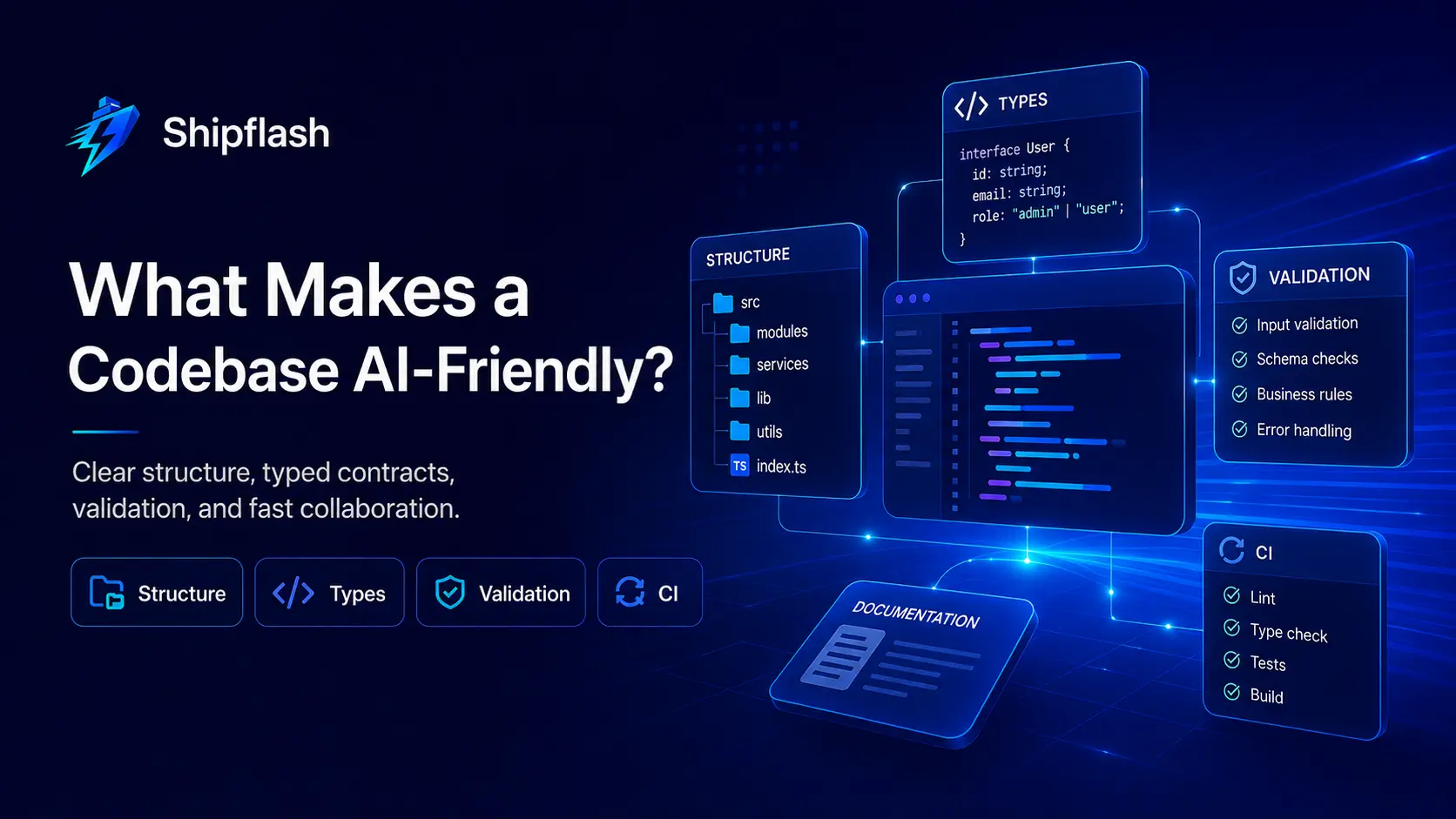
An AI-friendly codebase is not one with the most comments or the fewest files.
It is a codebase where intent, ownership, constraints and extension patterns are easy to discover.
That usually means:
Predictable module boundaries
Authentication logic should not be scattered across unrelated utility folders. Billing behavior should have an identifiable home. Database access should follow a consistent path.
A developer should be able to locate the code responsible for a business capability without searching the entire repository.
Explicit types and validated inputs
External input should enter the application as untrusted data.
Webhook bodies, form submissions, URL parameters and environment variables should be validated before they become trusted domain values.
This helps human developers, but it is especially useful when AI tools are making changes. Explicit contracts reduce the chance that generated code invents fields, assumes impossible states or bypasses validation.
Small, intentional interfaces
A module should expose the operations other modules need without exposing all its internal implementation details.
For example, the rest of the application should ask a billing module for the customer’s entitlement. It should not need to interpret raw subscription records in five different pages.
Documentation close to decisions
Useful documentation explains why a boundary exists, which extension point to use and what must remain true after a change.
It should not repeat every line of code.
High-value documentation includes:
- Architecture overviews
- Module responsibilities
- Security invariants
- Provider integration contracts
- Local-development instructions
- Deployment requirements
- Common extension examples
Automated quality gates
A written convention is easy to forget. A quality gate turns it into a repeatable check.
Type checking, linting, database validation, unit tests and critical-path end-to-end tests should run before changes are accepted.
The goal is not to maximize the number of checks. It is to catch mistakes that would create meaningful risk for a buyer or customer.
Which SaaS workflows deserve the strongest tests?
Not every visual variation needs an end-to-end test.
The highest-value tests cover workflows where a failure would affect access, money, data integrity or operational control.
These normally include:
- Registration, login and account recovery
- Protected-route and role enforcement
- Checkout and billing access
- Webhook signature and replay handling
- Subscription cancellation and expiration
- Administrative mutations
- Customer settings persistence
- Content publishing
- Database authorization boundaries
- Production build and deployment startup
Unit tests should cover isolated business rules. Integration tests should cover boundaries such as the database or provider adapter. End-to-end tests should prove that the most important customer journeys work as a complete system.
A smaller, intentional test suite is more valuable than hundreds of tests that only confirm implementation details.
How to evaluate a SaaS foundation before using it
Before choosing a starter foundation, look beyond the landing page and component count.
Ask these questions:
Can you understand the architecture?
The repository should explain where product logic, database access, UI components and provider integrations belong.
Are authorization rules enforced below the interface?
Hiding an admin button is not authorization. Sensitive actions should be protected on the server, and sensitive data should be protected at the database level where appropriate.
Does billing handle lifecycle events?
Look for duplicate-event protection, cancellation grace periods, refunds, failed payments, retries and reconciliation—not only checkout creation.
Can the product be safely customized?
A useful foundation should make common changes obvious. Replacing branding, adding a product module or changing a plan should not require reverse-engineering the entire repository.
Are failure states visible?
Errors should be logged with enough context to investigate them. Background operations should expose whether they succeeded, failed or need retrying.
Is the documentation written for work after installation?
Setup instructions are necessary, but buyers also need to understand how to extend, test, deploy and operate the product.
Does the codebase stay understandable as it grows?
The best time to establish module boundaries is before dozens of features depend on inconsistent patterns.
Should you build the foundation yourself?
Building everything internally can make sense when infrastructure itself is part of the company’s differentiation, when the team has unusual compliance requirements, or when existing foundations conflict with the intended architecture.
For many founders, however, authentication, webhook processing, administration and billing infrastructure are not the product customers are buying.
The real question is not whether your team can build these systems. It is whether rebuilding and maintaining them is the highest-value use of your time.
A reliable foundation can shorten the distance between an idea and the first product-specific workflow. It can also reduce the number of invisible infrastructure decisions that must be revisited after launch.
A practical SaaS launch-readiness checklist
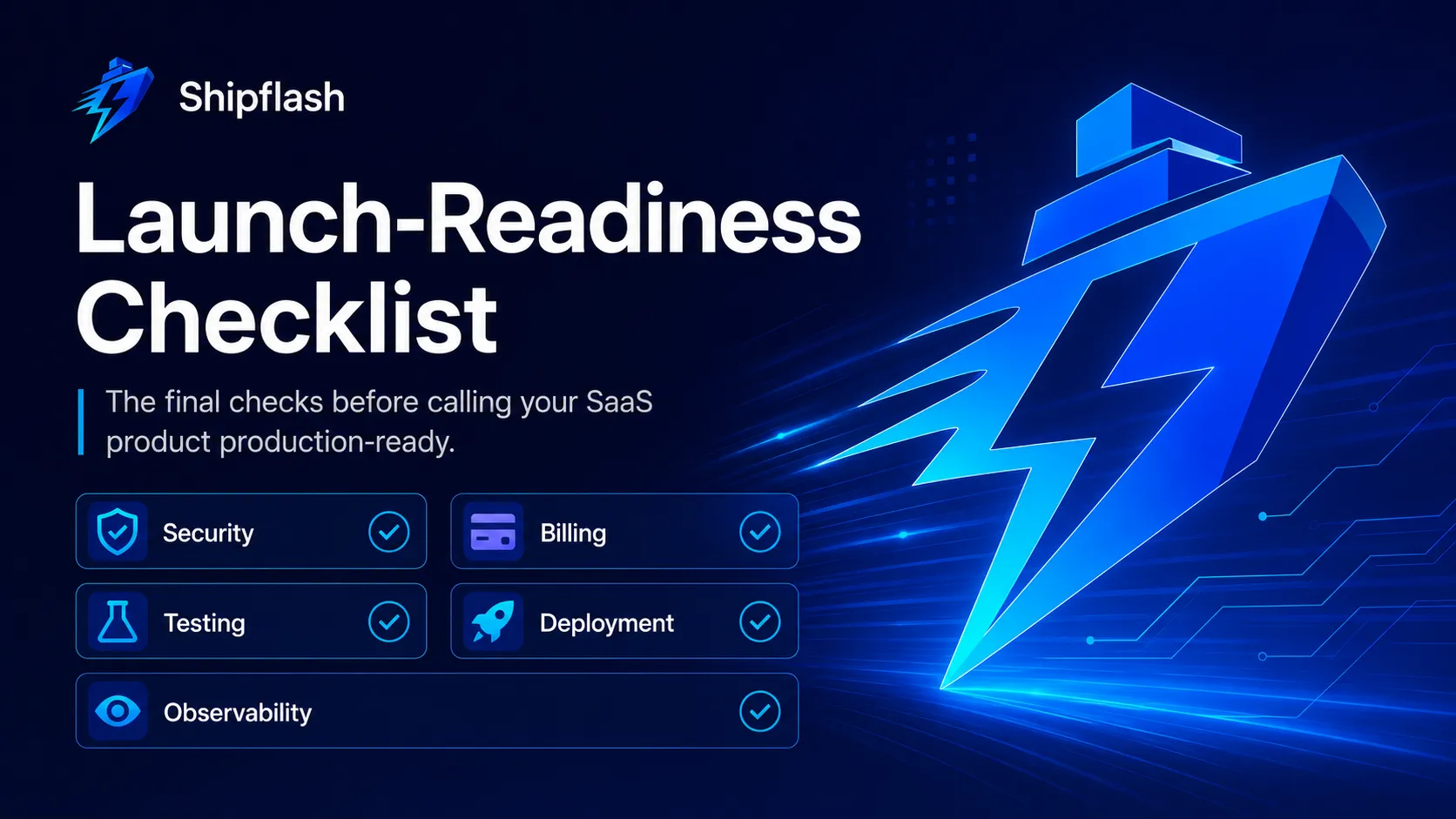
Before describing a SaaS product as production-ready, verify that:
- Authentication recovery and session expiration work
- Authorization is enforced on every sensitive mutation
- Database access policies have been tested
- Provider secrets are server-only
- Webhooks verify signatures and reject invalid payloads
- Duplicate events cannot duplicate business effects
- Billing access matches the customer’s actual entitlement
- Refund and cancellation behavior is defined
- Background tasks can be safely retried
- Important operations include traceable logs
- Environment variables are validated during startup
- Production builds run in continuous integration
- Critical customer journeys have automated tests
- Database migrations are repeatable
- Setup and extension documentation is current
- Private routes are excluded from indexing
- Public pages provide correct metadata, canonical URLs and sitemap entries
Next.js can generate metadata, robots directives and sitemaps through its App Router file conventions. Google recommends crawlable internal links, consistent canonical URLs and sitemaps containing the URLs a site considers important. flash fits
Shipflash is designed as a production-ready SaaS foundation rather than a collection of disconnected examples.
It gives founders, indie hackers, developers and small teams a structured base for essential product systems, including authentication, billing, administration, content, operational safeguards and a codebase organized for both developers and AI-assisted workflows.
The purpose is not to decide what your product should become.
It is to remove repetitive foundation work so you can spend more time on the workflows, customer problems and product advantages that make your SaaS worth choosing.
Building Faster Starts with the Right Foundation
A production-ready SaaS product is not defined by how quickly its first page was created. It is defined by how reliably its systems continue working when real customers, payments, permissions, provider failures, and product changes enter the picture.
The strongest SaaS foundations bring four things together:
- Essential product systems that are ready to extend
- Security boundaries enforced across the application and database
- Reliable billing, webhook, and operational workflows
- A maintainable architecture that developers and AI tools can understand
Next.js and Supabase provide powerful capabilities for building modern SaaS products, but frameworks alone do not create a production-ready application. The real advantage comes from the decisions around those technologies: where business logic belongs, how authorization is enforced, how external events are validated, how failures are recovered, and how future changes remain predictable.
Building all of this independently is possible. The question is whether authentication infrastructure, billing lifecycle handling, administrative tools, database policies, testing contracts, and operational safeguards are where your product creates its unique value.
For most founders and small teams, they are necessary systems—but they are not the reason customers choose the product.
Shipflash provides a production-ready SaaS foundation with essential product systems, scalable architecture, operational safeguards, and an AI-friendly codebase designed to remain maintainable as the product grows.
Instead of rebuilding the same infrastructure before reaching your actual idea, you can begin with a structured foundation and focus your time on the workflows, customer outcomes, and product advantages that make your SaaS worth paying for.
Start from a production-ready foundation. Build the product only you can build.
Buy once. Build with it for life.