
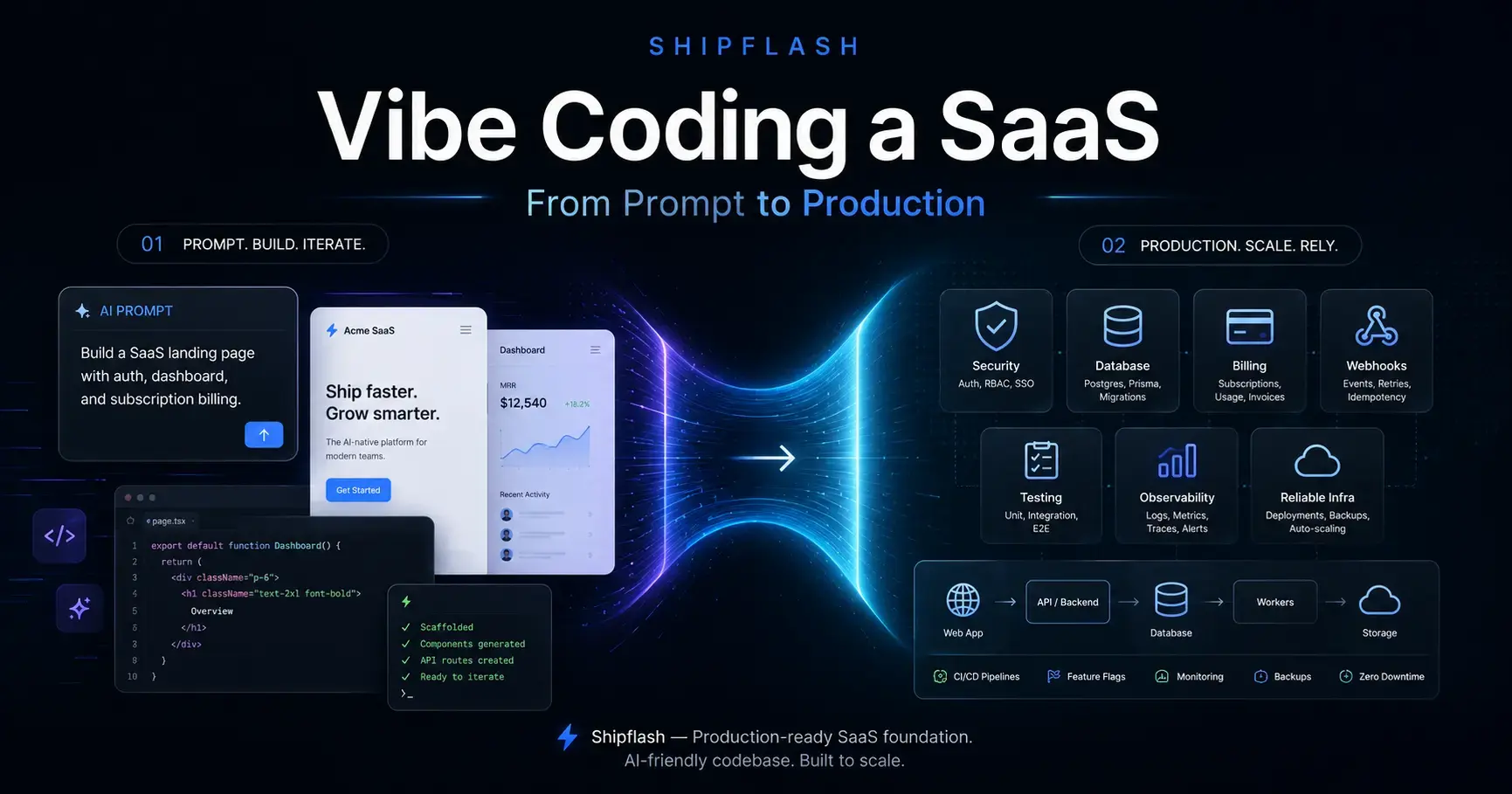
The first version is no longer the hardest part of building software.
You can describe a product in plain language, watch an AI coding agent generate the interface, connect a database, add authentication, and deploy something that looks surprisingly complete.
That changes what founders can attempt. It also creates a new problem.
A product can look finished long before it is ready for customers.
The dashboard loads. The signup flow works. The checkout opens. The database contains real records. From the outside, it may already resemble a functioning SaaS business.
But the difficult parts of production software often live beneath the interface. They appear when a customer pays twice, a webhook arrives late, an unauthorized request bypasses the page, a background job silently stops running, or the next AI-generated change breaks a business rule written three prompts ago.
So, can vibe coding build a SaaS?
Yes. Vibe coding can produce a useful SaaS prototype and accelerate large parts of product development. But it does not automatically make the resulting application secure, reliable, maintainable, or ready for production.
The difference between a promising demo and a trustworthy product is not how polished the interface looks. It is how the system behaves when something unexpected happens.
What does vibe coding actually mean?
Vibe coding is a prompt-driven way of building software in which you describe the desired result and let an AI system generate most of the implementation.
The phrase became popular in early 2025 after Andrej Karpathy described a highly hands-off development style where the builder follows the output, accepts generated changes, and pays relatively little attention to the underlying code.
Software developer Simon Willison later made an important distinction: using AI to write code is not automatically vibe coding. In conventional AI-assisted engineering, the developer still understands the architecture, reviews changes, verifies behavior, and remains responsible for the result. Vibe coding, in its stricter meaning, involves deliberately giving up some of that implementation-level control.
That distinction matters because the term is now used for several different workflows.
A founder generating a disposable prototype is vibe coding.
A developer using an agent to implement a carefully specified feature inside a tested codebase is doing something more controlled.
Both involve natural-language instructions. Only one assumes that a working result is enough.
For a prototype, that assumption may be perfectly reasonable. For a customer-facing SaaS product, it usually is not.
Why vibe coding works so well for SaaS prototypes
Most SaaS ideas begin as a workflow rather than a technical design.
You know that a customer should be able to create an account, configure something, receive a useful outcome, and pay when they need more. You may already understand the product better than you understand databases, server actions, deployment pipelines, or billing APIs.
AI coding tools are particularly good at closing that gap.
They can turn a written description into visible screens. They can create forms, dashboards, tables, onboarding steps, settings pages, landing pages, and basic integrations. This makes the product tangible much earlier.
That speed is valuable because early product development is full of unanswered questions.
Will people understand the workflow? Is the core result useful? Does the onboarding make sense? Is the product worth paying for?
You do not always need production-grade infrastructure to answer those questions. Sometimes a convincing prototype is exactly what you need.
The problem begins when the prototype succeeds.
Once users want access, the temporary implementation starts becoming permanent. Sample data becomes customer data. A test checkout becomes a real transaction. A manually triggered function becomes a scheduled operation.
The code did not suddenly become safer because the product found demand.
The production-readiness gap
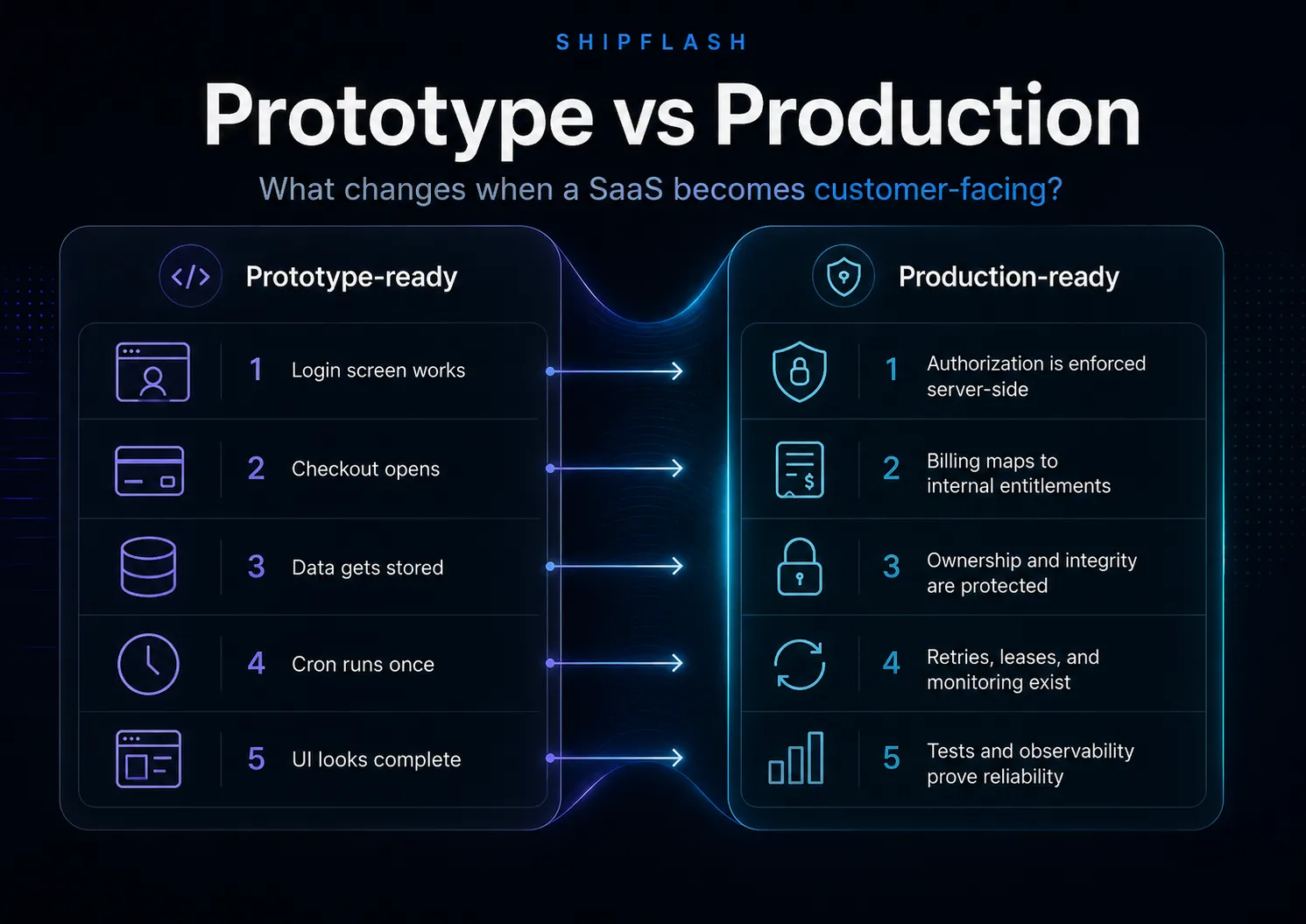
A prototype proves that one expected journey can succeed.
A production SaaS must continue behaving correctly across expected journeys, unexpected journeys, failures, retries, duplicated requests, malicious inputs, and future code changes.
Consider a subscription checkout.
In a prototype, the implementation may feel complete when a customer clicks Upgrade, finishes payment, and sees a success screen.
In production, the success screen is only the beginning.
What happens when the customer pays but closes the browser before returning to your application? What happens when the payment provider delivers the same webhook three times? What happens when a cancellation is scheduled for the end of the billing period? What happens when the customer receives a refund but your application still shows premium access?
The interface cannot answer those questions. The underlying system must.
| What the customer sees | What production software must handle |
|---|---|
| A login page | Secure sessions, account recovery, authorization, redirects, and abuse controls |
| A private dashboard | Server-side ownership checks and protected database access |
| An upgrade button | Product definitions, checkout state, entitlements, refunds, and reconciliation |
| A success notification | Confirmed server-side state rather than client-side assumptions |
| An automated email | Delivery failures, retries, duplicate prevention, and event history |
| A scheduled task | Authentication, concurrency control, leases, backoff, and monitoring |
| A working deployment | Valid configuration, safe migrations, logs, health checks, and recovery procedures |
This is why visually complete applications can still be operationally incomplete.
A 2026 benchmark of AI application-building platforms found that polished interfaces sometimes concealed missing or broken backend systems. Across the platforms evaluated, none exceeded 60% on the benchmark’s engineering-quality score, and background-job performance ranged from 0% to 49%. The authors describe this as a production-readiness cliff, while also noting that the findings come from a limited sample and require wider replication.
The takeaway is not that AI-generated applications never work.
It is that visual quality is a poor substitute for engineering evidence.
Can AI build an entire SaaS application reliably?
AI models can now complete much larger development tasks than simple code completion. They can navigate repositories, modify multiple files, run commands, fix errors, and iterate against tests.
They are still not consistently reliable across an entire application.
Vibe Code Bench evaluates AI models against full web-application specifications and browser-based user journeys rather than isolated programming exercises. In its initial 2026 results, the strongest model completed 58% of the held-out workflow evaluation successfully. The study also found that models that tested their own work during generation tended to perform better.
A score like that is impressive compared with where AI coding was only a few years ago.
It is also far below the level you would want for blindly deploying account access, billing logic, administrative permissions, and customer data.
Production software does not need to work most of the time.
The important paths must work predictably, and the system must fail safely when they do not.
Where a vibe-coded SaaS usually becomes fragile
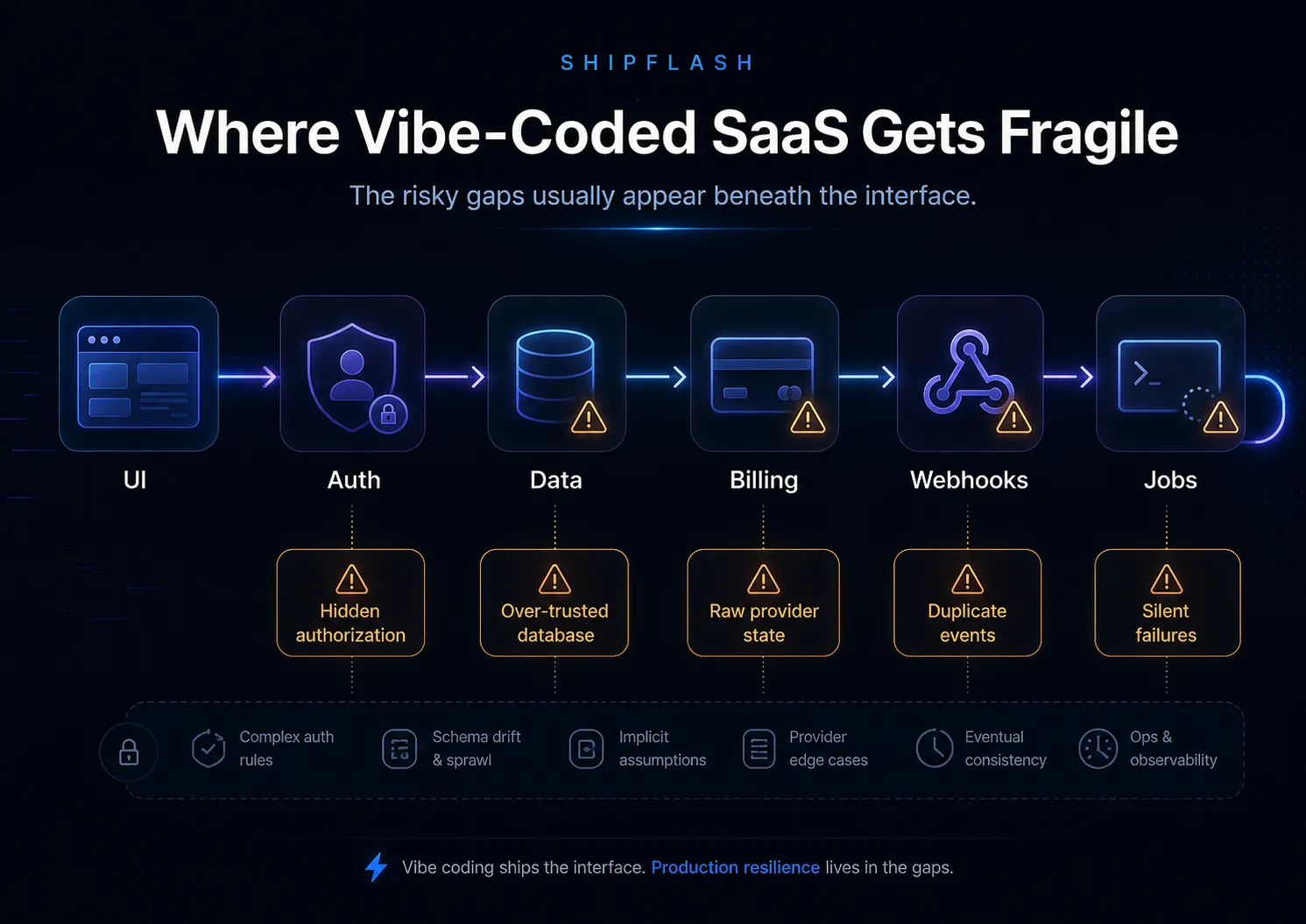
The most serious weaknesses are rarely obvious during the first walkthrough. They are hidden inside the boundaries between the customer, the application, the database, and external providers.
A hidden button is mistaken for authorization
Suppose an AI agent creates an admin page and hides the navigation item from ordinary users.
The interface now looks correct. Administrators see the page. Customers do not.
But hiding a link does not secure the operation behind it.
A customer may still call the route, API endpoint, server action, or database query directly. If authorization only exists in the interface, the protection disappears as soon as someone bypasses the interface.
OWASP recommends enforcing access control on the server and checking every request against the specific resource or operation being accessed. Client-side checks may improve the experience, but they should never make the final authorization decision.
This is one of the clearest examples of the difference between software that looks correct and software that is correct.
Authentication is expected to solve permissions
Authentication establishes who the user is.
Authorization determines what that user may do.
Those are separate responsibilities.
A logged-in customer should not automatically be allowed to access another customer’s records, change workspace roles, invoke administrative operations, synchronize payment-provider state, or read internal reports.
An AI-generated application may implement login successfully while leaving the permission model vague. The ambiguity often goes unnoticed because everyone testing the application uses the same account.
The weakness only becomes visible when there are multiple customers, multiple workspaces, or multiple roles.
The database trusts the application too much
A page might request only records belonging to the current user. That makes the interface appear private.
But what prevents a modified request from asking for another user’s records?
For sensitive data, the answer should not depend on the interface behaving honestly. Ownership and access rules should be enforced at trusted layers, such as the server and database.
Constraints also matter for correctness.
A unique constraint can prevent the same provider event from being processed twice. A foreign key can prevent a record from referencing something that no longer exists. A transaction can ensure several related updates either succeed together or fail together.
Without these protections, the database becomes a passive storage bucket for whatever the generated application sends it.
Billing is reduced to a checkout button
Checkout is the visible part of billing.
The difficult part is maintaining correct access after the payment.
A payment provider knows about customers, subscriptions, invoices, transactions, disputes, refunds, and payment states. Your product needs to answer a different question:
What is this customer allowed to use right now?
Those two questions overlap, but they are not identical.
A cancelled subscription may remain usable until the end of its billing period. A lifetime purchase may not have a subscription at all. A customer may receive credits, a manual entitlement, a trial extension, or a partial refund.
If application access depends directly on one provider status, every new product rule becomes a provider-specific exception.
A stronger design separates the commercial catalog, the state reported by the payment provider, the access granted inside the application, and the history of events that changed that access.
The provider remains responsible for the transaction.
The application remains responsible for the product.
Webhooks are designed for the happy path
Payment providers, email services, and other platforms often notify your application through webhooks.
Those events may be delayed. They may be retried. The same event may be delivered more than once. Two events may arrive in an order you did not expect.
A webhook that works during one dashboard test may still fail under real delivery behavior.
The system needs to verify where the event came from, identify whether it has already been processed, record the outcome, and apply changes safely. A failure should be retryable without granting access twice or sending the same message repeatedly.
This is the kind of requirement that is easy to omit from a prompt because it is not visible on the finished screen.
Background jobs quietly stop working
Many SaaS products depend on work that happens after the user leaves the page.
Emails are delivered. Provider state is synchronized. usage is calculated. expired access is removed. failed operations are retried. old records are cleaned up.
A scheduled endpoint may run correctly during development and still be unsuitable for production.
What happens when two executions overlap? How does the system know that the previous worker crashed? When should a failed task be retried? How can an operator tell when the job last succeeded?
If nobody can answer those questions, the automation is running on hope.
Each new prompt introduces a new architecture
AI agents solve the task in front of them using the context they currently have.
If the repository does not make its architecture obvious, each feature may introduce another way to validate input, check permissions, read configuration, access the database, handle errors, or communicate with providers.
One generated feature may be clean. Twenty generated features may become twenty slightly different systems.
That is architectural drift.
It rarely begins with a dramatic mistake. It begins with duplicate helpers, business logic inside interface components, provider-specific conditions scattered through the codebase, and folders that no longer communicate where anything belongs.
Eventually, even the AI agent has difficulty understanding what should be reused and what should be replaced.
Security is a workflow problem, not only a code problem
It is tempting to treat security as something that can be added after generation.
Run a scanner. Fix the warnings. Hide the secrets. Ship.
That approach misses the deeper issue.
Security decisions are made throughout the development process. They appear when the system decides where trust begins, who owns a record, which component may perform an operation, how a provider event is verified, and what happens when required information is missing.
A June 2026 study examined a corpus of more than 10,000 repositories identified as predominantly vibe-coded and manually audited a sample of 200 publicly deployed applications. The researchers reported that 90% of the audited applications contained at least one validated vulnerability, with broken access control among the most common categories. As with any newly published study, its identification method and sample should be considered when interpreting the findings, but the results reinforce that the risk extends beyond isolated insecure code snippets into architecture and workflow decisions.
A smaller application is not automatically safer.
It may contain fewer files, but a single incorrect permission check can still expose every customer record.
The better model: generate features on top of a trusted foundation
The answer is not to stop using AI.
It is to stop asking AI to reinvent every foundational decision whenever you start a product.
A production-oriented SaaS foundation gives the project an established way to handle the recurring parts of a customer-facing application.
Identity follows one session model. Protected operations use one authorization pattern. Database access follows defined boundaries. Billing state is translated into internal product access. External events have an idempotency strategy. Background jobs expose their health. Tests preserve business rules after the conversation that created them is gone.
This changes the role of the AI agent.
Instead of inventing the foundation, it learns from the foundation.
Instead of deciding where a new database operation belongs, it follows an existing feature structure. Instead of creating another billing condition inside a page component, it uses the entitlement model. Instead of claiming a feature is finished because the interface renders, it has tests and contracts to satisfy.
The freedom is narrower, but the outcome is more predictable.
That is usually a good trade when customers are involved.
From vibe coding to production-oriented AI development
Simon Willison later proposed “vibe engineering” to distinguish low-stakes, result-driven experimentation from the more demanding process of producing AI-assisted code that can be maintained with confidence.
He argues that coding agents reward established engineering practices such as planning, automated testing, documentation, and version control. These practices give the agent useful feedback and give the human a way to verify what changed.
The name may continue evolving. The workflow matters more than the label.
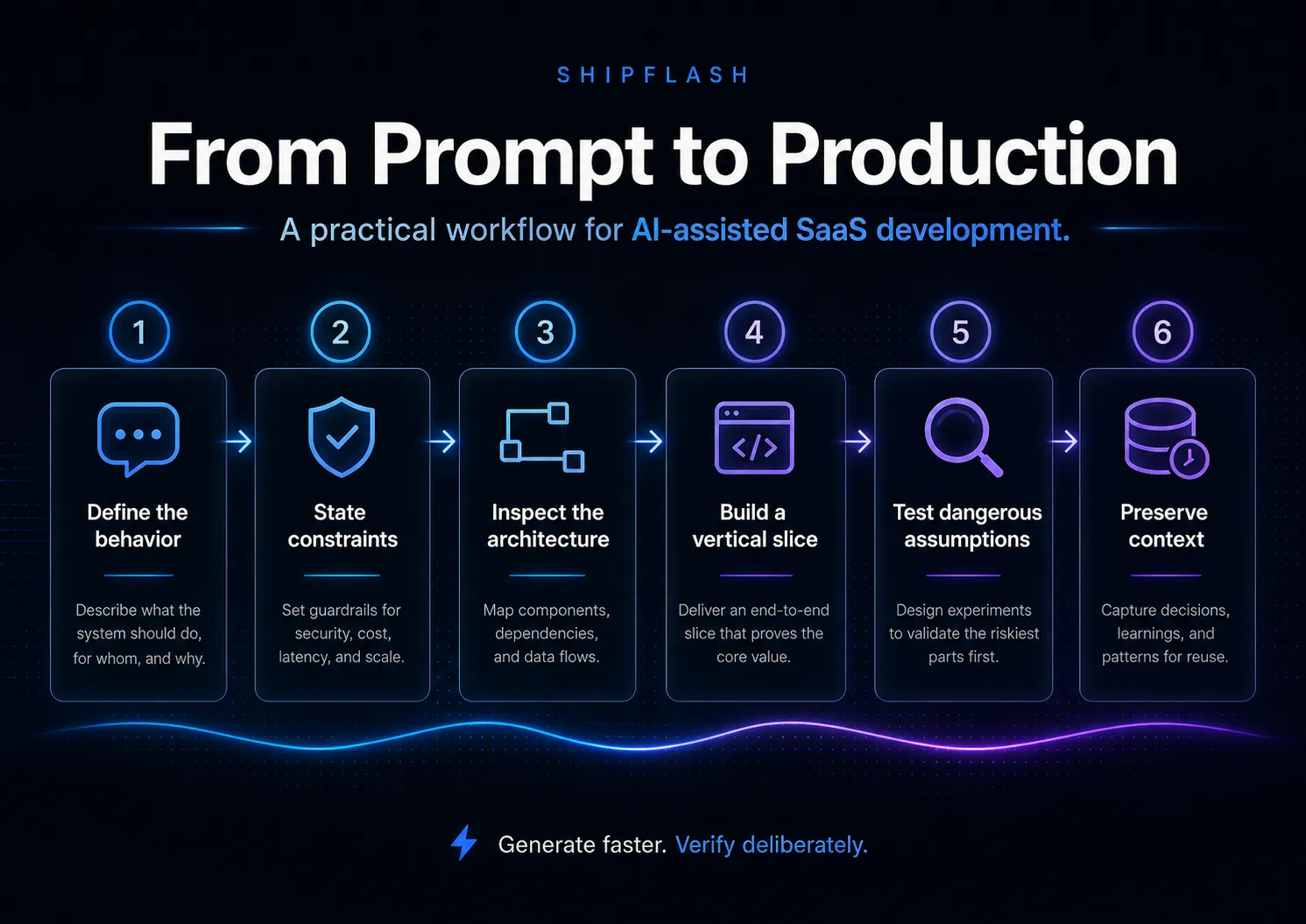
Here is what that workflow looks like in practice.
Start with the behavior, not the interface
“Build a subscription settings page” describes a screen.
It does not describe the product.
A useful specification should explain who can access the page, where the displayed state comes from, which actions are allowed, how cancellations behave, and what should happen when the payment provider cannot be reached.
That context prevents the AI from filling important gaps with convenient assumptions.
GitHub’s guidance on spec-driven development makes a similar argument: the specification should become a shared source of truth that guides planning, implementation, and validation rather than a document written after the code already exists.
Ask the agent to inspect before it edits
Before generating code, the agent should identify the existing architecture.
Where is authorization enforced? How are server-side errors represented? Which validation library is already used? Where does billing logic live? Which tests cover the affected behavior?
This inspection phase may feel slower than immediately requesting an implementation.
It is usually much faster than cleaning up a second architecture created beside the first one.
Build one complete path
A complete vertical slice is more useful than five disconnected screens.
For example, a customer action should travel through validated input, server-side permission checks, business logic, persistence, a clear result, error handling, and tests.
Following the entire path reveals whether the pieces actually work together.
A beautiful interface connected to placeholder behavior does not.
Test the dangerous assumptions
The most useful tests are not always the most visible.
Can one customer request another customer’s resource? Can the same webhook be processed twice? What happens when an external provider times out? Can a background operation resume after a crash? Does a refund affect access correctly?
These questions describe the behavior that customers will eventually depend on.
Research on end-to-end AI application generation has also found self-testing to be associated with stronger outcomes, while an experience report on production-oriented vibe coding found that access control, isolation, and asynchronous processing were often under-specified unless deliberately defined.
Review the change, not just the result
The page working in the browser is one form of evidence.
The code change is another.
Review whether unrelated files were modified, whether existing abstractions were reused, whether types were bypassed, whether secrets moved into client code, and whether business rules were duplicated.
The goal is not to understand every character the AI typed.
The goal is to understand the system you are accepting responsibility for.
Preserve context after the conversation ends
The chat that produced a feature is temporary.
The repository is permanent.
Important decisions should survive as tests, documentation, typed contracts, migration history, operational notes, and clear module boundaries.
That durable context helps the next developer. It also helps the next AI agent.
Without it, every new conversation begins by rediscovering—or reinventing—the product.
Does vibe coding replace a SaaS boilerplate?
No. A coding agent and a SaaS foundation solve different problems.
The agent accelerates implementation.
The foundation reduces the number of foundational decisions that need to be invented during implementation.
Starting from an empty repository offers maximum freedom. It also requires someone—or something—to define authentication, authorization, database access, billing, webhooks, configuration, testing, observability, and project structure.
An AI agent can make those decisions.
The issue is whether it will make them consistently across every feature and every future session.
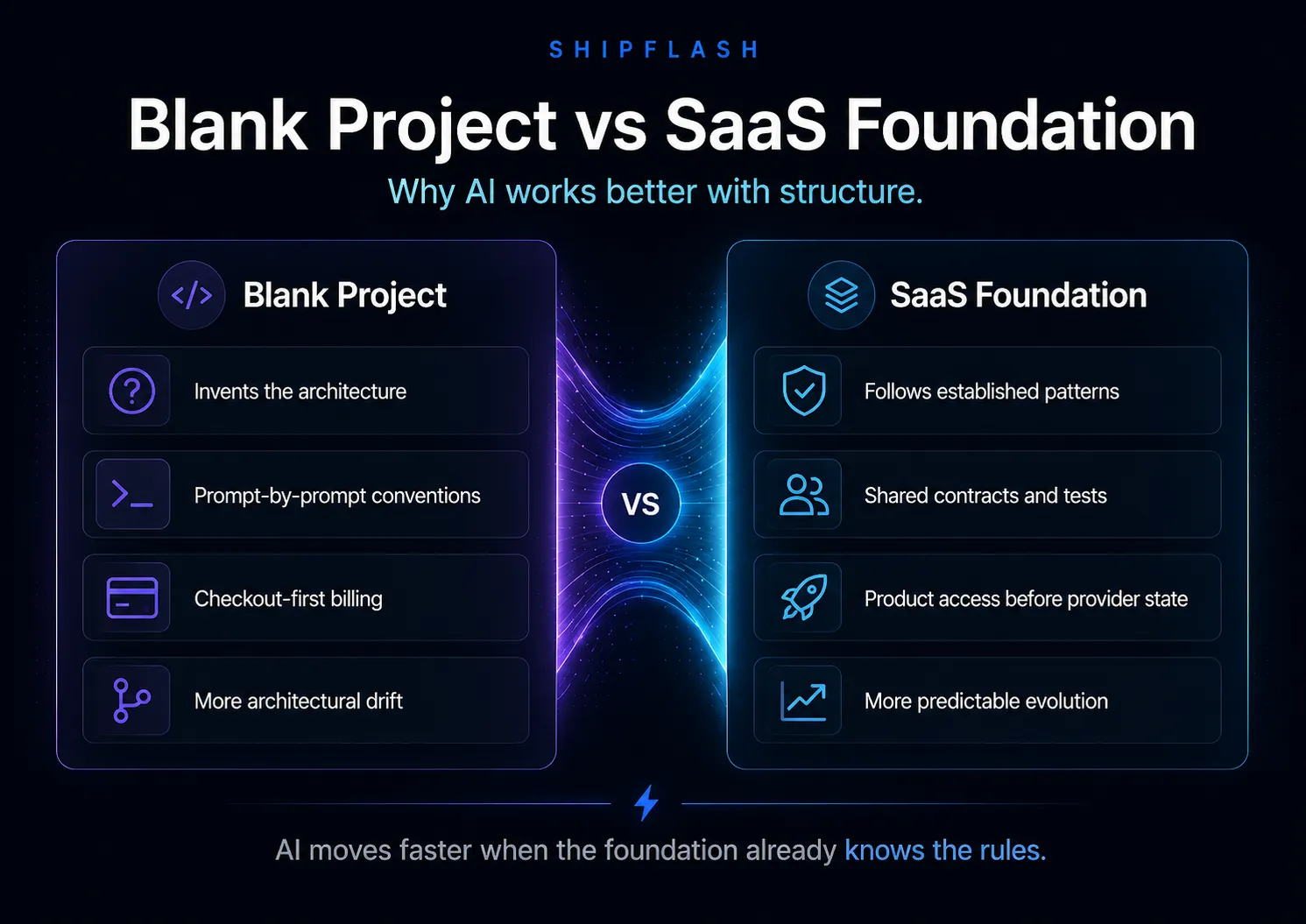
| Starting from a blank project | Starting from a SaaS foundation |
|---|---|
| The AI invents the initial architecture | The AI follows an established architecture |
| Product rules begin inside prompts | Product rules can live in shared contracts and tests |
| Billing often starts with checkout | Billing starts with product access and provider boundaries |
| Security depends heavily on prompt completeness | Security patterns already exist for the agent to reuse |
| Each session can introduce new conventions | Quality gates expose architectural drift |
| More time goes into recurring infrastructure | More time can go into the differentiated product |
A foundation does not guarantee production readiness.
It does give both the human and the AI a better starting point.
When is pure vibe coding enough?
Pure vibe coding is a good fit when the cost of failure is low and the purpose is exploration.
A temporary prototype does not need the same operational safeguards as a billing platform. A personal utility using sample data does not carry the same risk as a product storing customer accounts. A landing-page experiment can favor speed over architecture.
The standard should rise when the product begins handling trust.
That includes private customer information, payments, workspace permissions, public uploads, automated communications, usage-based costs, or business-critical workflows.
The size of the application is not the deciding factor.
The consequences of incorrect behavior are.
A practical production-readiness test
Before launching a vibe-coded SaaS, do not ask only, “Does it work?”
Ask what the system does when the expected path stops being expected.
| Area | Question to answer before launch | Warning sign |
|---|---|---|
| Access | Can a user reach data or actions belonging to another account? | Protection exists only in the interface |
| Data | What prevents invalid, duplicated, or orphaned records? | Correctness depends entirely on application code |
| Billing | How is provider state translated into product access? | A raw subscription status controls everything |
| Webhooks | Can the same event run twice without duplicating the outcome? | No stable event identity or processing history |
| Jobs | How are failed and overlapping executions handled? | The job only records console output |
| Errors | Can a production failure be traced to a customer request or provider event? | Logs contain only generic messages |
| Testing | Which automated checks protect the highest-risk journeys? | Verification is entirely manual |
| Maintainability | Can the next feature follow an obvious existing pattern? | Similar logic appears in several unrelated places |
| Recovery | How can incorrect state be inspected and repaired? | The only recovery method is editing the database manually |
You do not need a perfect answer for every row before serving your first user.
You do need to know which risks you are accepting.
How Shipflash approaches AI-assisted SaaS development
Shipflash is built around the idea that AI coding tools perform better when they are given a clear, production-oriented environment to work within.
The purpose is not to generate your differentiated product for you.
It is to provide structure around the systems that many SaaS products repeatedly need: authentication, billing, administration, customer management, content, notifications, configuration, testing, and operational safeguards.
That structure matters for human developers because it reduces repetitive setup.
It matters equally for AI agents because it provides patterns they can inspect.
When a project already has clear boundaries, the agent does not need to decide from scratch how a protected action should work, where billing state belongs, how provider events are recorded, or how a feature should be organized.
The result is not unlimited generation.
It is constrained acceleration.
That is a more useful promise for a product intended to survive beyond its first demo.
The real bottleneck has moved
For years, the difficult part of software development was producing the first implementation.
AI has reduced that cost dramatically.
The new bottleneck is confidence.
Can you trust the authorization rules? Can you explain the billing state? Can you recover from a failed job? Can you modify the product six months from now without breaking behavior that nobody remembered to document?
These are not arguments against vibe coding.
They are signs that vibe coding has become useful enough for the next stage of the conversation to matter.
The more code AI can generate, the more valuable clear specifications, architecture, automated tests, and operational visibility become.
Speed creates more opportunities.
Structure helps those opportunities survive.
Frequently asked questions about vibe coding a SaaS
Can vibe coding build a complete SaaS product?
Vibe coding can generate a large portion of a SaaS application, including its interface, database integration, authentication flow, and common product features. A complete customer-facing product still needs verification of permissions, billing behavior, data protection, external events, failure recovery, and maintainability.
Is vibe coding safe for production?
It can be used as part of a production workflow, but generated output should not be assumed safe simply because it works. High-risk areas such as authorization, secret handling, payments, data ownership, and infrastructure configuration require deliberate review and testing.
What is the difference between vibe coding and AI-assisted engineering?
Vibe coding generally prioritizes directing and evaluating the visible result while paying less attention to the implementation. AI-assisted engineering uses similar tools but retains explicit specifications, architectural control, code review, testing, and human responsibility for the finished system.
Do I need to understand code to launch a vibe-coded SaaS?
You do not necessarily need to write every line yourself, but someone must be able to verify, operate, and maintain the resulting application. As the product handles more sensitive data and business-critical behavior, the need for technical oversight increases.
Does a SaaS boilerplate limit what AI can build?
A good foundation constrains recurring infrastructure without defining the unique product. The AI can still build custom workflows, domain logic, interfaces, and integrations while following established patterns for security, billing, data access, and testing.
What should I test before launching an AI-generated SaaS?
Start with the journeys that create the greatest customer or business risk: account access, cross-user data isolation, payments, refunds, duplicated webhooks, administrative permissions, failed external services, and recovery from partially completed operations.
Can I make an existing vibe-coded application production-ready?
Yes, but the amount of work depends on the architecture already generated. Begin by mapping identity, authorization, data access, billing, external events, background jobs, and configuration. Then fix the highest-risk boundaries before adding more features.
Vibe fast. Launch deliberately.
Vibe coding is one of the most powerful ways to turn an idea into working software.
It enables founders to test products earlier, helps small teams attempt more ambitious projects, and gives developers leverage across repetitive implementation work.
That speed should be used.
It should not be confused with trust.
A customer does not care how quickly the application was generated. They care whether their account remains secure, whether their payment grants the correct access, whether their data stays private, and whether the product still works tomorrow.
The strongest approach combines both sides.
Use AI to move quickly through creation.
Use specifications, architecture, tests, and operational safeguards to make the result dependable.
That is how a vibe-coded prototype becomes a SaaS product people can actually rely on.